


A hand-hammered brass vessel sink, one of Insideast's core bathroom sink materials. Browse the full sink collection.
The best bathroom sink for 2027 is not a single product; it is the combination of material, mounting style, and size that fits your counter and how you actually use the room. For most buyers, that means solid brass or copper for durability and character, an installation style chosen to match the countertop you already have, and a basin sized to leave real counter space on either side. Here is how to work through each of those decisions before you buy.
- Material drives long-term durability more than any other choice. Solid brass and copper resist chipping and only improve with age, unlike ceramic.
- Vessel, undermount, and drop-in sinks all work in a bathroom; the right one depends on your counter material and how much visible rim you want to see.
- For small bathrooms, oval or round basins and wall-mounted sinks free up the most usable counter and floor space.
- ADA lavatory guidance caps an accessible sink at 34 inches from the floor, with 27 inches of knee clearance; most residential vanities sit lower, around 30 to 32 inches.
- Match your sink's finish to your faucet early. Mixed metals can work, but a matched brass or copper pairing is the simplest way to get a cohesive look.
What makes a bathroom sink "best" for your space
Three things decide whether a sink will still feel like the right choice five years from now: material durability, how well the mounting style suits your countertop, and whether the size and shape fit the vanity you have. A striking sink that is the wrong size for a small powder room, or a beautiful basin in a material that scratches within a year, is not the best sink for that bathroom, regardless of how it photographs.
Style should follow those filters, not lead them. Once you know your countertop material, your available width, and how much maintenance you want, the remaining choice becomes finish and shape rather than guesswork.
Materials compared: brass, copper, German silver, ceramic, and stainless
Material is the single biggest factor in how a bathroom sink performs over time, and it is where the widest quality gap between options actually sits.
| Material | Durability | Maintenance |
|---|---|---|
| Solid brass | Excellent. Non-porous and does not chip or crack; develops a living patina rather than wearing out. | Occasional wipe with mild soap; no sealants needed. |
| Solid copper | Excellent, with a naturally antimicrobial surface and the same resistance to chipping as brass. | Same low-maintenance wipe-down as brass; patinas at a similar rate. |
| German silver | Very good. A copper, nickel, and zinc alloy with a brighter, cooler tone and good corrosion resistance. | Low; wipes clean and ages more slowly than brass toward a soft grey patina. |
| Ceramic / vitreous china | Moderate. Glossy and easy to clean, but chips or cracks on hard impact. | Standard bathroom cleaners; avoid abrasive scouring pads on the glaze. |
| Stainless steel | Good for resisting stains and cracks, but shows water spots and scratches more visibly over time. | Frequent drying to avoid mineral spotting; specialty steel cleaner for scratches. |
Solid brass leads this comparison for a reason beyond looks. Unlike ceramic or stainless, a scratch in solid metal does not expose a different layer underneath, it just becomes part of the same surface, which is why a brass or copper sink tends to look better, not worse, with years of use.
As a rule of thumb: pick ceramic if budget is the deciding factor and you don't mind replacing the sink sooner. Pick stainless if you want a neutral look with low visual maintenance concern for a rented or short-term space. Pick brass for a warm, traditional look you don't mind wiping down occasionally. Pick copper for the same durability with a redder, more dramatic patina. Pick German silver if you want that same solid-metal durability in a cooler tone that suits a more modern or minimal bathroom.

Solid hammered copper, one of Insideast's core sink materials alongside brass.
Where copper differs from brass
A cooler warmth, the same durability
Copper shares brass's resistance to chipping, but starts from a redder, warmer base tone that ages toward deep browns rather than brass's ambers and bronzes. Both metals are solid through the whole basin, not plated, so the finish never wears through.
The case for German silver
A brighter, cooler alternative to brass
German silver is an alloy of copper, nickel, and zinc typically cited at around 60% copper, 20% nickel, and 20% zinc, and despite the name contains no actual silver. The nickel content gives it a cooler, whiter tone than brass, suiting bathrooms where a warm gold metal would clash, while keeping the same solid-metal durability.

A smooth oval German silver sink, drop-in style.
"Everything is fine; the product matches the image on Etsy. Delivery time was also fine. Therefore: recommended."

Choosing by sink type: vessel, undermount, and drop-in
Once material is settled, mounting style is the next filter, largely decided by your countertop rather than taste alone.

A vessel sink sits on top of the counter. View this sink
Vessel
Sits on the counter, most decorative
A vessel sink sits entirely above the counter rather than being cut into it, making it the easiest style to install on an existing vanity and the most visually striking of the three. It raises the effective height of the basin, so it usually pairs with a slightly lower vanity than an undermount or drop-in setup.
Undermount
Mounted beneath the counter, easiest to clean
An undermount sink is fixed to the underside of the countertop, so the counter edge runs directly into the basin with no rim in between, and no seam to trap water or grime, making it the easiest of the three to wipe clean. It requires a precisely cut opening, so it pairs best with solid stone or solid-surface counters and is usually a two-step job between a fabricator and a plumber.
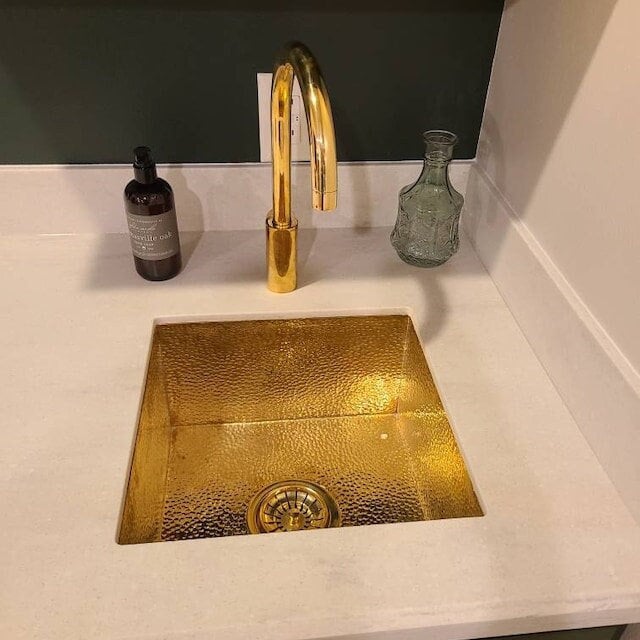
This hammered undermount profile also suits bathroom vanities in solid stone or solid-surface counters. View this sink

A decagon drop-in sink. View this sink
Drop-in
Rests in a pre-cut hole, the most forgiving
A drop-in sink has a built-in rim that rests on top of the counter around a standard pre-cut hole. It works with almost any countertop material, including laminate and tile, and is the simplest of the three for a single plumber to install. The tradeoff is the visible rim, a seam where crumbs and water can collect.
For installation steps and countertop pairings in more depth, see choosing a vessel sink and undermount vs drop-in installation.
Which type fits your bathroom
The type that photographs best is not always the type that holds up to how a specific bathroom gets used every day. Match the sink to the room first, then choose finish and material within that.
| If you're working with | Choose | Why |
|---|---|---|
| A guest powder room or half bath | Vessel or wall-mount | Visual impact matters more than daily wear; a striking basin gets noticed in a room used briefly. |
| A busy family or kids' bathroom | Undermount | No rim to catch toothpaste and splashes; wipes clean in one motion, which matters with heavy daily use. |
| A laminate or tile countertop | Drop-in | Works with almost any surface and does not need a precision-cut, sealed edge the way undermount does. |
| A primary bathroom with existing storage | Undermount or drop-in | Keeps the vanity and cabinet intact for everyday toiletries, unlike vessel or wall-mount. |
| A very tight footprint or accessible layout | Wall-mount | Removes the vanity entirely, freeing floor space and simplifying knee clearance underneath. |
| A stone or solid-surface counter you're installing new | Undermount | The material best suited to a precise cutout; wastes the counter's clean line if paired with drop-in instead. |
Best sinks for small bathrooms
In a small bathroom, basin shape and mounting style matter more than material choice. Oval and round basins leave more usable counter space on either side than large rectangular ones, and a wall-mounted or vessel sink frees up floor space a bulky vanity cabinet would otherwise take.
Height is worth planning deliberately too. Most residential vanities sit at 30 to 32 inches, with comfort-height vanities closer to 34 to 36 inches. For an accessible layout, the U.S. Access Board's ADA lavatory guidance caps the rim or counter at 34 inches from the floor, with 27 inches of knee clearance beneath. A vessel sink adds height on top of the vanity, so it usually pairs with a lower cabinet.
Finish choice matters more in a small bathroom than a large one, since there is less room for the eye to look elsewhere. A lighter material, ceramic, stainless, or a bright stone, reflects more light back into a room with limited natural light than a dark stone or a heavily patinated brass would. If the room gets good daylight, a warmer brass or copper finish reads as intentional rather than dim; if it does not, lean lighter.
Real-World Setup


@jacumbahotspringshotel: "Our guest rooms are now open for bookings here at Jacumba Hot Springs Hotel." A compact guest bathroom setup, faucet, sink, and p-trap, in the kind of small footprint many home bathrooms are working with too. View post
"An absolute pleasure to deal with this company. Brilliant customer service and fantastic product."

Best sink and faucet pairings
The fastest way to make a bathroom sink look finished is to match its metal to the faucet. A brass sink with a matching unlacquered brass faucet reads as one deliberate material story instead of two competing finishes, and the two age at the same rate, so the patina stays consistent.

A geometric hammered basin that pairs naturally with an unlacquered brass single-hole faucet.
View product
Pairs well with an oil-rubbed or aged-brass faucet for warm, contrasting metal tones.
View collection
A cooler-toned basin that suits a nickel or chrome faucet finish rather than warm brass.
View productBrowse the bathroom faucet collection to find a matching finish for any of the sinks above.
Frequently Asked Questions
Common Questions About Choosing a Bathroom Sink
What is the best material for a bathroom sink?
Solid brass and copper are the most durable choices; both are non-porous, resist chipping, and improve with age. Ceramic is affordable but chips on impact. Stainless steel resists stains but shows water spots easily. German silver, a copper, nickel, and zinc alloy, offers a brighter, cooler tone with similar durability to brass.
What is the standard height for a bathroom sink?
Most vanities sit between 30 and 32 inches high, with comfort-height vanities closer to 34 to 36 inches. ADA guidance caps an accessible lavatory at 34 inches from the finished floor, with 27 inches of knee clearance beneath. A vessel sink adds a few inches on top of the vanity, so the cabinet is usually built shorter to compensate.
What shape is best for a small bathroom sink?
Oval and round basins generally fit small vanities better than large rectangular ones, leaving more usable counter space on either side. A wall-mounted sink removes the vanity entirely and is the most space-efficient option for a tight bathroom, though it sacrifices under-sink storage.
Is a vessel sink better than an undermount sink for a small bathroom?
A vessel sink reads as more decorative but raises the effective height, so it works best with a lower vanity. An undermount sink keeps the countertop line clean and is easier to wipe down, but needs a cut counter. Neither is objectively better; it depends on counter height and cleaning preference.
Do brass bathroom sinks need special maintenance?
Unlacquered brass and copper sinks need only an occasional wipe with a damp cloth and mild soap; no sealants required. Left alone, the surface darkens into a patina over months of use. A light wax coat slows that process if you want to keep the brighter tone longer.
Every sink in this guide is handmade in the Insideast workshop in Marrakech, in solid brass, copper, or German silver. Browse the full bathroom sink collection, or pair one with a matching finish from the bathroom faucet collection.


