


Unlacquered brass wall sconce, warm ambient light against a plaster wall.
Wall sconces are the easiest brass fixture to get wrong, not because they are complicated, but because they get treated as an afterthought. Height, spacing, and finish all matter more with sconces than with almost any other fixture in the house, since they sit at eye level and stay there permanently. They also age differently than a faucet or a handle. Here is where they work, how high to mount them, and how their patina compares to fixtures you touch every day.
- Sconces patina more slowly than faucets since they are rarely handled once installed.
- Hallway and living space sconces generally sit 60 to 66 inches from the floor, at roughly eye level.
- Bedside sconces typically mount 30 to 36 inches above the top of the mattress.
- In bathrooms, keep sconces away from direct water spray and confirm the fixture is rated for a damp location before installing.
- Matching the finish family across sconces, faucets, and hardware reads as intentional rather than mismatched.
Where wall sconces work best (and where they don't)
Sconces earn their place in a few specific spots: flanking a mirror, mounted in pairs beside a headboard, spaced down a hallway, or bracketing a fireplace or piece of art. In each case, the fixture is doing a job a ceiling light can't do well, either lighting a face evenly, freeing up nightstand space, or filling a corridor without a run of recessed cans.
They work less well as a room's only light source. A single sconce or even a symmetric pair reads as ambient or task lighting, not general illumination, so a living room relying only on sconces will usually still feel underlit. Mounting height matters just as much as room choice: if the bulb itself sits at eye level rather than the fixture's shade or body, expect glare instead of a flattering glow.

Lit unlacquered brass sconce. The warm cast comes from the brass itself, not just the bulb.
Ambient, not overhead
The light reads differently off brass
Unlacquered brass reflects light with a warmer cast than painted or plated metal, which is part of why sconces in this finish tend to look inviting rather than clinical, even at low wattage.
That warmth is a reason to lean into ambient placement, hallways, bedsides, entryways, rather than asking one sconce to light an entire room on its own.
Bathroom sconces: humidity and unlacquered brass
Unlacquered brass sconces work fine in a bathroom as long as two things are true: the fixture is rated for a damp location, and it isn't mounted where it will take direct water spray. That second condition rules out the interior of a shower enclosure, which is a different fixture category entirely, but it doesn't rule out a vanity wall or the space beside a mirror.
Humidity itself is the bigger factor for how the finish behaves over time, more than water contact. Bathrooms run consistently more humid than the rest of the house, and that moisture is part of what drives the oxidation reaction that produces patina in the first place.
Worth Noting
Moisture in the air is a necessary part of the chemical reaction that darkens copper-based alloys like brass, which is why humid rooms and humid climates generally show faster, more even patina development than dry ones.
Source: Urban EDC, "How Patina Works on Copper, Brass & Bronze"
Practically, that means a bathroom sconce will likely darken a little faster than one in a dry hallway, but it won't be damaged by the humidity, since unlacquered brass has no coating to fail. Always confirm the fixture's wet or damp-location rating with an electrician before installing near a sink or shower, since local electrical codes vary and this article isn't a substitute for that check.
Bedroom and hallway: height and spacing rules
These two rooms are where sconce placement gets the most literal. In a bedroom, sconces usually replace a nightstand lamp, mounted in a symmetric pair on either side of the headboard. A common starting height is 30 to 36 inches above the top of the mattress, or roughly a few inches above shoulder height for someone sitting up against the pillows. That range isn't a fixed rule, it depends on mattress height, headboard style, and how the person in the room actually reads in bed, so treat it as a starting measurement to confirm on the wall before drilling.

Oxidized copper sconce styled as a bedside light, mounted in place of a table lamp.
Bedside pairs
Symmetry matters more here than anywhere else
Bedside sconces are almost always installed in matching pairs at identical height on both sides of the bed. Any inconsistency in mounting height is far more noticeable here than in a hallway, since both fixtures sit in the same sightline.
In a hallway, the goal shifts from task lighting to even, walkable light. A general starting height is 60 to 66 inches from the floor to the center of the fixture, close to eye level, with sconces spaced roughly 6 to 8 feet apart along the wall. Narrower hallways or dimmer bulbs may need closer spacing to avoid dark patches between fixtures.

"Perfect! Beautiful and on time!"
How sconces age differently from faucets
A faucet gets gripped, turned, and splashed with water and soap dozens of times a day. A wall sconce, once wired and mounted, is rarely touched again except to change a bulb. That difference in handling is the main reason sconces patina more slowly and more evenly than faucets in the same unlacquered brass finish.
Worth Noting
Skin oils and sweat contain salts and acids that accelerate oxidation on copper-based alloys, meaning surfaces that get handled frequently tend to darken faster and less evenly than surfaces exposed mainly to air.
Source: Urban EDC, "How Patina Works on Copper, Brass & Bronze"
Practically, this means a sconce and a faucet installed on the same day, in the same room, will not look identical a year later. The faucet develops darker, uneven patina concentrated at the handle and spout, driven by daily contact. The sconce ages more uniformly across its whole surface, driven mainly by ambient air and light rather than touch. Neither is a flaw, it's simply two different aging paths for the same base metal.
Pairing sconces with other brass fixtures for cohesion
A sconce doesn't need to be an identical model to a room's faucet or cabinet hardware, but staying in the same finish family reads as a deliberate design choice rather than a mismatch. An unlacquered brass sconce paired with unlacquered brass cabinet pulls and a faucet will age together, all deepening in color at roughly the same rate. Mixing a warm, aging brass sconce with a bright, lacquered fixture nearby tends to look accidental instead of layered, since one surface is changing and the other is frozen.
For a kitchen specifically, pairing wall sconces with pendant lighting over an island is a common way to build that cohesion without every fixture being the exact same piece; the guide to brass and copper pendant lights for kitchen islands covers how to pick a pendant that complements rather than competes with wall lighting nearby. If mixing aged brass with an antique-style finish, the breakdown of aged brass vs antique brass finishes is worth reading first, since the two are often confused but age differently.

"I love my new lights, they are absolutely beautiful! I ordered 3 to use in my kitchen and the finish is so gorgeous that I've decided to buy more for the rest of the house."
That instinct, buying more of the same finish once one room looks right, is exactly the cohesion this section is describing. For the foundational logic of why unlacquered brass finishes work together across a whole house, see unlacquered brass: what it is and how it ages.
Insideast sconce options
The full range is in the wall sconces collection, alongside the broader lighting collection for pendants and table lamps in the same finishes. A few starting points by use case:
| Style | Best for | Product |
|---|---|---|
| Oxidized copper, swing arm | Bedside reading, adjustable direction | Oxidized copper wall sconce |
| Brushed brass, hallway | Hallways and entryways | Brushed brass hallway sconce |
| Unlacquered brass, wall mount | Bedside pairs, kitchens | Unlacquered brass sconce |
| Brushed brass, gooseneck | Reading nooks, directional task light | Brass gooseneck sconce |
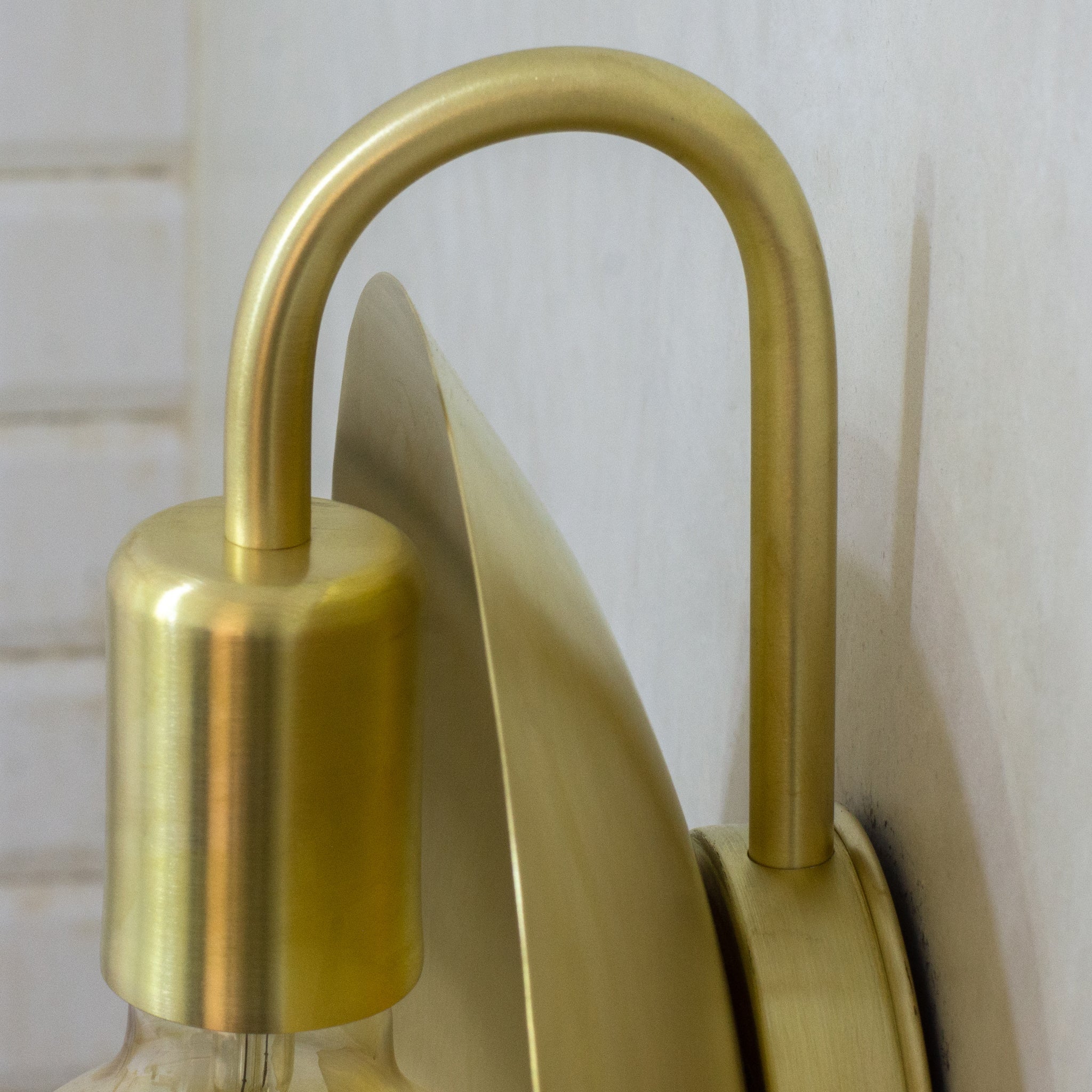
Close-up of the brushed brass wall dish sconce, showing the hand-finished surface texture.
Detail worth checking
Look for the surface texture up close
Hand-finished brass shows small, honest variation at this distance, slightly different tool marks between pieces, which is one of the fastest ways to tell a genuinely handmade sconce from a cast, uniform factory piece.

"The wall lamp is beautiful. The seller is very prompt with returning messages."
- Confirm the fixture is wet or damp-rated if it's going in a bathroom.
- Measure the mounting height on the actual wall before drilling, not just from a general guideline.
- Order pairs at the same time for bedrooms, so the finish ages consistently on both sides.
- Check the finish family against existing faucets and hardware in the room.
Frequently Asked Questions
Common Questions About Unlacquered Brass Wall Sconces
Where should wall sconces be placed?
Wall sconces work best in hallways, entryways, bedside pairs flanking a headboard, and beside bathroom mirrors. They are less suited as the only light source in a large room, since they provide ambient or task light rather than full-room illumination, and should not be mounted where the bulb sits at direct eye level, since that causes glare.
How high should wall sconces be mounted?
As a general starting point, hallway and living space sconces are mounted around 60 to 66 inches from the floor to the center of the fixture, roughly eye level. Bedside sconces typically sit 30 to 36 inches above the top of the mattress. Both figures should be adjusted for ceiling height and the height of the people using the room.
Do unlacquered brass wall sconces patina?
Yes, but more slowly than a faucet or door hardware. Patina develops mainly from oxygen, humidity, and skin contact, and a wall sconce is rarely touched once installed. Expect an even, gradual darkening driven by air and ambient humidity rather than the faster, handling-driven patina seen on fixtures that get gripped daily.
How far apart should hallway sconces be spaced?
A common starting spacing is 6 to 8 feet apart along a hallway wall, which keeps the light even without dark gaps between fixtures. Narrower hallways or lower-output bulbs may need closer spacing, while wider halls with brighter bulbs can space further apart.
Do wall sconces need to match other brass fixtures in the room?
Not exactly, but staying within the same finish family reads as intentional rather than mismatched. Pairing an unlacquered brass sconce with an unlacquered brass faucet or cabinet pull works because both age the same way. Mixing an aged brass sconce with a bright, lacquered fixture tends to look accidental instead of layered.
Every sconce in this guide is designed and hand-finished in the same Marrakech workshop as the rest of the Insideast range. Browse the wall sconces collection, or read more customer reviews.


