


Choose a single-handle faucet for fast, one-handed use and compact sinks. Choose a double-handle faucet for finer temperature control, a classic look, and a second handle that can keep working if the first one leaks. Handle count is not hole count: a single-hole faucet can have one lever or cross handles, so check your sink and your style together.
Single-handle or double-handle? The right answer depends on how you use the sink, what it is drilled for, and the look you want, not on one type being better. This guide covers how each works, why handle count is different from hole count, the trade-offs, and which to pick for a kitchen or a bathroom. It points to our other guides for the detail on holes, installation, and repairs, so you can decide quickly.
- A single-handle faucet has one control for flow and temperature. A double-handle faucet has separate hot and cold handles.
- Handle count is separate from hole count: single-hole faucets come with one lever or with cross handles.
- Double-handle generally gives finer temperature control. Single-handle is quicker and easier with one hand.
- If a part fails, a double-handle faucet can keep working on one side, while a single-handle faucet needs both supplies shut off.
How each type works
A single-handle faucet uses one mixing cartridge: one lever sets both flow and temperature. A double-handle faucet gives each supply its own valve, so the hot handle and the cold handle each control their own cartridge, and the water meets before it leaves the spout. Our two-handle bridge faucets, for example, give each handle its own ceramic cartridge.
Handle count is not hole count: a single-hole faucet can have one lever or cross handles. Our single-hole faucet guide and faucet hole size guide cover holes, so this guide stays on handles. Here are examples from the range.

Single-handle · bathroom
Heritage single-lever wall-mount bathroom faucet
One lever controls flow and temperature with one hand. Rough-in valve included.
View product
Single-handle · kitchen
Single-hole kitchen mixer tap, island faucet
One lever and one deck hole, with hot and cold lines included. Also listed for bathroom sinks.
View product
Double-handle · bathroom
Heritage 3-hole wall-mount bath faucet
Wall-mounted with two handles and ceramic cartridges. Rough-in valve included.
View product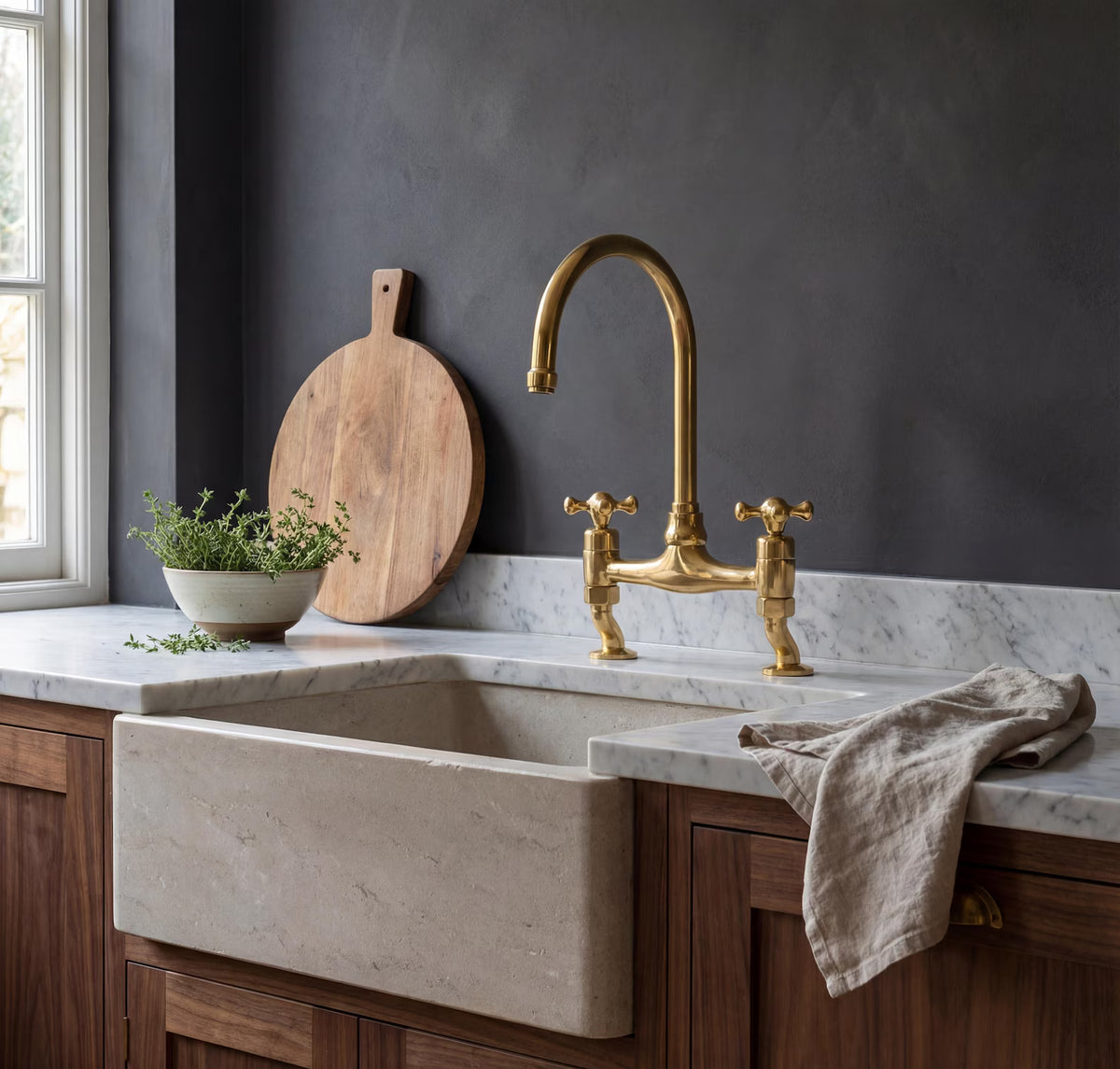
Double-handle · kitchen
Bridge kitchen faucet with curved legs
A classic two-handle bridge style for a 2-hole sink, with Simple, Flat or Lever handle options.
View productPros and cons at a glance
| Feature | Single-handle | Double-handle |
|---|---|---|
| Operation | One lever, usable one-handed | Two handles, so two hands or two movements |
| Temperature | Quick to set, harder to dial in an exact mix | Separate hot and cold, so finer control |
| Look | Streamlined and modern | Classic, with a more substantial presence |
| Space and holes | Compact; one or two holes | Usually two or three holes, or a wall rough-in |
| If a part fails | Both supply valves off, and the faucet is unusable until fixed | Shut off one side, and the other handle can still work |
| Parts to maintain | Fewer | More |
| Grip | Lever is easier with limited hand strength | Cross handles are easier to grip wet, from any angle |
Most of these points follow Angi's single-handle vs double-handle comparison. For the cross versus lever detail in a kitchen, see our kitchen faucet styles guide, and for what goes wrong and how to fix it, our faucet repair guide.
Which to choose: kitchen vs bathroom
Kitchen. A single-handle faucet suits busy cooking: one hand, even a messy one, and quick temperature changes. A two-handle bridge style suits a traditional or period kitchen, and the look is the main reason to choose it. Bathroom. A single-handle faucet suits small vanities and one-hole sinks. A widespread two-handle faucet suits a larger vanity with three pre-drilled holes. Wall-mounted faucets need an in-wall rough-in, covered in our wall-mount faucet guide.
Choose Single-Handle If
- You want one-handed, quick adjustments
- The sink is small or drilled for one hole
- You prefer a streamlined, modern look
- You want fewer parts to maintain
Choose Double-Handle If
- You want finer control over temperature
- The room is traditional, vintage, or period
- The sink is already drilled for two or three holes
- You like the idea of one side working if the other leaks

If grip or accessibility matters, the U.S. Access Board's guide to operable parts notes that lever-shaped handles are acceptable under the ADA rule that controls be usable with one hand, without tight grasping, pinching, or twisting of the wrist. That rule applies to accessible installations, but it is a useful benchmark for any home.
Frequently Asked Questions
What is the difference between single-handle and double-handle faucets?
A single-handle faucet has one lever that sets both flow and temperature through a mixing cartridge. A double-handle faucet has separate hot and cold handles, each with its own valve. Single-handle is faster and works with one hand, while double-handle usually gives finer temperature control and a more traditional look.
Which is better, a single-handle or double-handle faucet?
Neither is better for everyone. Choose single-handle for speed, one-handed use, and compact sinks. Choose double-handle for precise temperature control and a classic look. Your sink's existing holes and your style matter as much as the handle count, so check both before you buy.
Is a single-handle faucet the same as a single-hole faucet?
No. Handle count is how many controls you operate, while hole count is how many openings the faucet needs. A single-hole faucet can have one lever or cross handles, and a double-handle faucet can be a bridge, widespread, or wall-mounted style. Check both before choosing.
Which is easier to repair, single-handle or double-handle?
A single-handle faucet has fewer parts, but when one fails you shut off both supply valves and cannot use it until it is fixed. A double-handle faucet has more parts, yet you can shut off one side and keep using the other handle. Either way, the fix is usually a cartridge or seals.
Whichever you choose, check it against your sink's hole layout first. Browse our single-hole faucets or our widespread 3-hole faucets.


