


Solid brass, handmade in Marrakech. Browse the full sinks collection.
What customers say before reading further
"Best brass sinks and drains in the world! We bought 4 custom brass sinks and drains for our newly renovated main floor and they look spectacular! Excellent fast customer service."
Both materials are genuinely durable. Neither one fails in a normal kitchen within any reasonable timeframe. The real question buyers are asking is narrower: which one still looks good after a decade of daily use, not just which one survives it. The answer depends entirely on what you want a sink to do as it ages.
- Both materials commonly last 20 to 30+ years in residential use. Lifespan is not really the differentiator.
- Stainless steel stays visually the same throughout its life. Solid brass changes, developing a patina that most owners come to prefer over the original finish.
- Stainless resists dents better. Brass resists corrosion better and never rusts.
- Maintenance is roughly equal: a few minutes a week for either material, just managing different things.
- Weight is the simplest quality check for either material: a thin-gauge stainless sink flexes and booms, a solid brass sink does not.
The fundamental material difference
Stainless steel is an alloy of iron, chromium, and nickel. The chromium forms an invisible oxide layer on the surface that resists rust and keeps the metal looking essentially identical from the day it is installed to the day it is removed. That stability is the entire point of the material.
Solid brass is an alloy of copper and zinc. Left unlacquered, the surface reacts to air, water, and handling. This is not a flaw in the metal. It is the intended behaviour of an unlacquered finish. Over months and years it darkens from bright gold into deeper amber, brown, and bronze tones, a process covered in detail in our guide on how unlacquered brass ages.
Neither reaction is better in the abstract. Stainless is engineered to resist change. Brass, left unlacquered, is allowed to show it. Which one you want depends on whether a sink showing 10 years of use looks, to you, like wear or like character.
Durability: scratch, dent, and stain resistance, compared honestly
| Factor | Stainless Steel | Solid Brass (Unlacquered) |
|---|---|---|
| Scratches | Visible permanently; no self-repair mechanism | Blend into developing patina within weeks |
| Dents | Thin-gauge sinks can dent under heavy impact | Solid brass resists denting due to mass and density |
| Rust / corrosion | Resistant, but can pit or rust at scratches over time in poor-quality grades | Never rusts; brass does not contain iron |
| Water spots | Show clearly on the reflective surface | Minimal visible impact once patina has developed |
| Acidic staining | Generally resistant | Can lighten patina locally; recovers with normal use |
The dent question comes down almost entirely to gauge and mass, not just material category. A thin 18-gauge stainless sink will dent under a dropped cast iron pot. A solid brass sink, cast and machined rather than pressed from sheet metal, has far more mass to absorb the same impact. Pick it up before buying, if you can. Weight is the fastest honest signal of how any solid brass fixture will hold up over time.

The test that works every time
Lift it before you buy it.
A solid brass sink has noticeable heft. Thin stainless sinks feel light and can sound hollow when tapped. A quality heavy-gauge stainless sink will also feel substantial, so weight is not a brand-loyalty test, it is a manufacturing-quality test that applies to both materials equally.
Maintenance: which is actually easier day to day
Stainless steel needs regular wiping to avoid water spots and fingerprint marks on its reflective surface, plus occasional use of a stainless-specific cleaner to keep the original shine. Skipping this does not damage the sink, it just looks streaky.
Unlacquered brass needs a similar quick wipe-down after use, plus an occasional wash with mild soap and warm water, detailed fully in How to Clean Brass: We Tested 5 Effective and Easy Methods for You!. The one real restriction: avoid bleach, ammonia, and abrasive scouring pads, which can strip patina unevenly. Neither sink demands more than a few minutes a week under normal household use. The difference is what you are maintaining for: stainless toward sameness, brass toward an evolving look.
"This is a beautiful vessel, communication was great throughout the process keeping me up to speed on timing. Also really good conversation about how the copper changes color, how to care for it and overall product usage. Would highly recommend."

Conversations like this are exactly what the Insideast team does on every order: walking buyers through how the metal will change, what to expect in the first few months, and how to care for it once it arrives. That same guidance is written out in full in our How metal changes & how to care, so you are never guessing once the sink is installed.
Aesthetics: which ages better over 10 years
This is where the two materials genuinely diverge, and it is the part most comparison content glosses over. A stainless sink at year 10 looks like a slightly worn version of itself at year one: visible fine scratches that accumulate and never fade, a duller sheen than when new, the same essential colour and character throughout.
A solid brass sink at year 10 looks meaningfully different from year one, and most owners describe that difference as an improvement. The surface deepens from bright gold into rich amber, brown, and bronze tones with genuine depth and variation, the same living-finish quality described in our guide on lacquered vs unlacquered brass. No two brass sinks age identically, because the patina responds to your specific water chemistry and usage patterns.
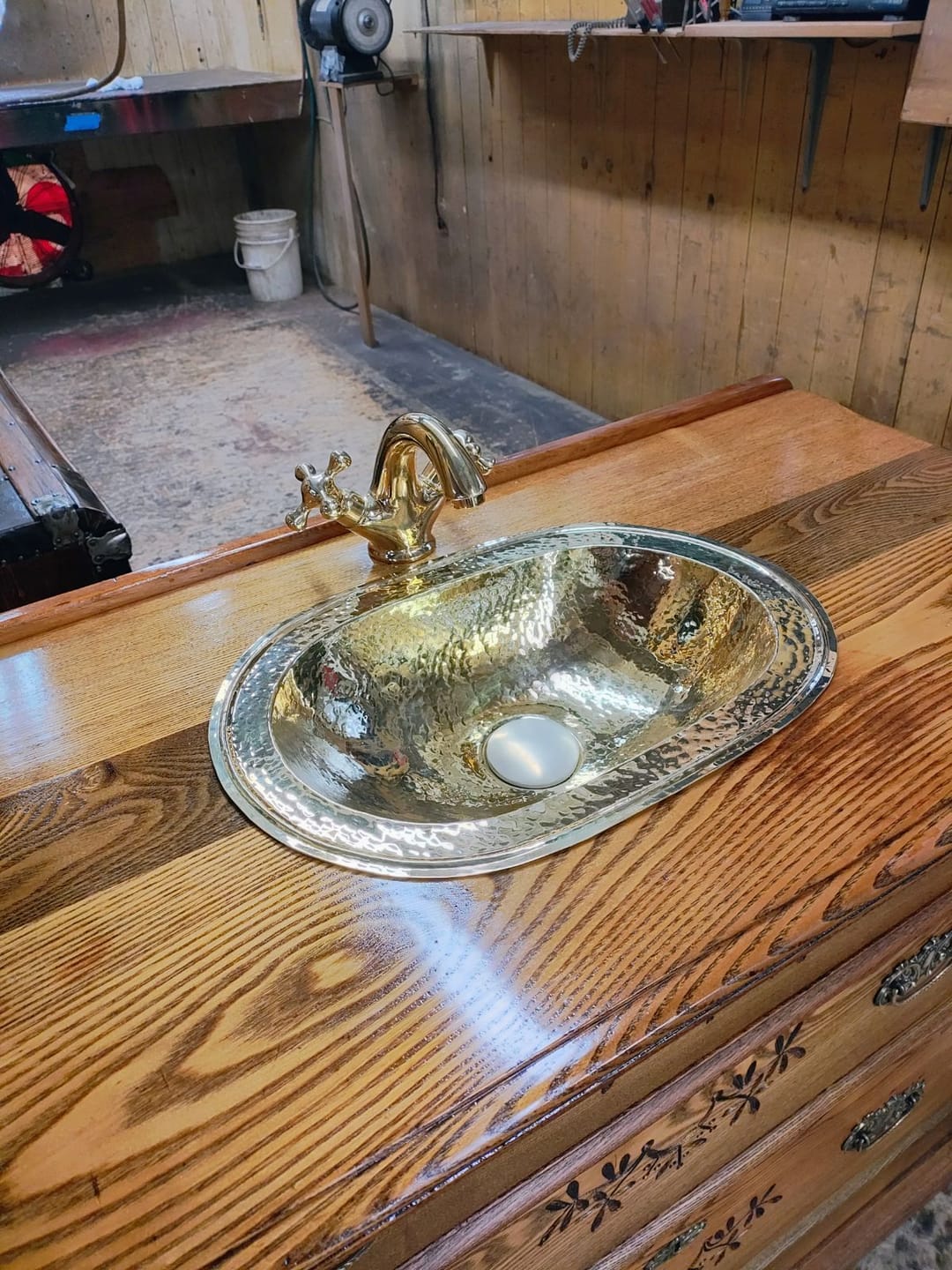
"I absolutely love how this 1800's oak dresser, a beautiful hand crafted brass sink and matching faucet created my one-of-a-kind bathroom vanity. Thank you for offering these hand crafted brass pieces of art. Great communication and shipping."
What stainless can never do is develop character. It is engineered specifically to resist this kind of change. That is a genuine advantage if consistency is what you want from a sink. It is a genuine limitation if you are hoping the sink will look better, not just the same, after a decade of use.
True cost over time, not just purchase price
Purchase price varies enormously within each category depending on gauge, brand, and whether brass is solid or plated. A fair comparison has to look past the sticker price to what each material actually costs you over its lifespan.
Stainless steel costs
- Lower typical entry price for thin-gauge models
- Visible scratches are permanent; no restoration option
- Resale or replacement value drops once scratched or dulled
- No ongoing cost beyond basic cleaning supplies
Solid brass costs
- Higher typical entry price, reflecting solid metal and handmade construction
- Marks and light wear are absorbed into the patina rather than lost value
- A brass polish can fully restore the original finish at any point, reversible at no real cost
- Factory-direct pricing narrows the gap versus comparable design-house brass
The detail that changes the calculation: stainless wear is a one-way loss. Brass wear is reversible and, left alone, becomes part of what people are actually paying for. That is the core asymmetry between the two materials over a 10-year ownership period.
Honest recommendation for each scenario
Choose stainless steel if your kitchen sees heavy commercial-style use, you want zero visual change over time, or you are working with a tight budget and need a dependable, low-maintenance basin.
Choose solid brass if the sink is also a design feature in the room, you are drawn to the warmth of a living finish that ages alongside other unlacquered brass details in your kitchen, and you are comfortable with a few minutes of weekly care in exchange for a sink that improves rather than just survives.
Many of our customers split the difference: a stainless prep sink in a secondary work area, and a solid brass main basin where it is seen and used daily. Both choices are reasonable. Neither one is wrong. The honest answer to "which lasts longer" is that both last for decades; the real question is which kind of decade you want to look at.
The installation alternative
Undermount brass ages the same way
The patina argument holds regardless of installation style. An undermount solid brass sink develops the same living finish as any other unlacquered brass basin, and many of the same durability arguments against stainless apply equally here, whether the basin sits in a kitchen island bar or a main prep area. If you are still deciding on installation type, our undermount vs drop-in brass sink guide covers that choice in full.

"What a marvel. Looking at such fine craftsmanship is like admiring a work of art, and every time you pause on this vanity basin and bridge faucet, you fall under its spell."
That reaction, treating a sink and faucet as a piece worth pausing on rather than just a fixture, is the aesthetic case for brass in a single sentence. It is also why so many of our customers photograph their sinks years after installation: the patina becomes part of the story of the room, something a stainless basin never offers.
Frequently Asked Questions
Is a brass sink better than stainless steel?
Does brass scratch easier than stainless steel?
How long does a brass sink last?
Is brass or stainless better for a kitchen sink?
Do brass sinks need more maintenance than stainless steel?
Every Insideast sink is handmade in our Marrakech workshop from solid brass, not plated zinc, and ships worldwide with a 5-year warranty and printed installation guide. Browse the full sinks collection to compare styles and weight against whatever you currently have in mind.


