


Unlacquered brass hardware and accessories. Handmade in Marrakech. The most-touched fixtures in any home age the fastest.
No fixture in your kitchen gets touched as often as a cabinet knob or drawer pull. A faucet handle gets a quick turn. A knob gets gripped, pulled, released, dozens of times a day, every day. That difference matters if you are choosing unlacquered brass hardware: the same living finish that ages slowly on a pendant light or a bathroom faucet develops noticeably faster on something your hand meets every single day.
This guide covers how to choose between knobs, pulls and handles for different cabinets, how the patina actually develops on high-touch hardware, how to mix unlacquered brass with other kitchen finishes without it looking like a mistake, and how to keep hardware and faucets ageing into the same warm tone over time. If you already have an Insideast faucet and are now shopping for matching hardware, this is written for you specifically.
- Unlacquered brass cabinet hardware patinas faster than any other fixture type because it is handled constantly. Expect visible change within weeks, not months.
- Knobs suit upper cabinets and smaller drawers. Pulls suit base cabinets and wide drawers. Handles work for heavier or larger doors that need a fuller grip.
- High-touch patina is two-toned by design: a brighter, burnished spot where fingers land, surrounded by deepening amber-gold everywhere else. This is normal, not uneven wear.
- Unlacquered brass pairs well with painted cabinets, stone counters and most other kitchen finishes. The pairing that needs more thought is mixing it with chrome or stainless steel appliances.
- Ordering hardware and faucets from the same workshop means both age through the same patina process, so they stay visually consistent over years rather than diverging.
- Why unlacquered brass cabinet hardware is trending
- Knobs vs pulls: which for which cabinet
- How the finish ages on frequently-touched hardware
- Mixing unlacquered brass with other kitchen finishes
- Kitchen vs bathroom hardware: what's different
- Matching hardware to your faucets: finish cohesion
- Frequently asked questions
Why unlacquered brass cabinet hardware is trending
Cabinet hardware is a small purchase with an outsized visual effect. A kitchen with twenty cabinet doors and drawers has twenty to forty individual touchpoints of finish, more than any single faucet or light fixture contributes. That is part of why unlacquered brass hardware has become one of the fastest-moving categories in kitchen design: it lets a homeowner introduce warmth and texture across the whole room without replacing a single cabinet box.
The other part of the trend is consistency with a broader shift already happening in kitchens and bathrooms. Homeowners who chose unlacquered brass faucets for their living-finish character are now extending the same material to hooks, knobs and pulls, so the whole space ages together rather than having one fixture that patinas and everything else that stays static.

4-pack brass dresser pulls. Solid brass, sold as a set for consistent finish across multiple drawers.
Highest volume, lowest competition
A search term competitors haven't claimed
Unlacquered brass cabinet hardware is searched roughly 1,000 times a month in the US with very little competing content. Most of what ranks today is product listings, not guides, which is unusual: it means there is real demand from people who want to understand the material, not just buy it blind.
Knobs vs pulls: which for which cabinet
Knobs and pulls are not interchangeable, even though they get grouped together in most shopping categories. Each suits a different cabinet type and a different grip motion.
Knobs
A knob is a single fixed point, round or geometric, mounted with one screw from behind the door. They work best on upper cabinet doors, where the door is light and a fingertip grip is enough to swing it open, and on smaller drawers where a full-hand pull is not necessary. Knobs are also the easiest hardware to mix finishes with, since their small footprint reads as an accent rather than a dominant visual element.
Pulls
A pull is a bar mounted on two screws, giving a full-hand grip. Pulls suit base cabinets and wide or heavy drawers, where you need more leverage to open a loaded drawer smoothly. They are also the better choice on pantry doors and any cabinet that gets opened with one hand while the other is occupied, since a bar is easier to grab without looking.
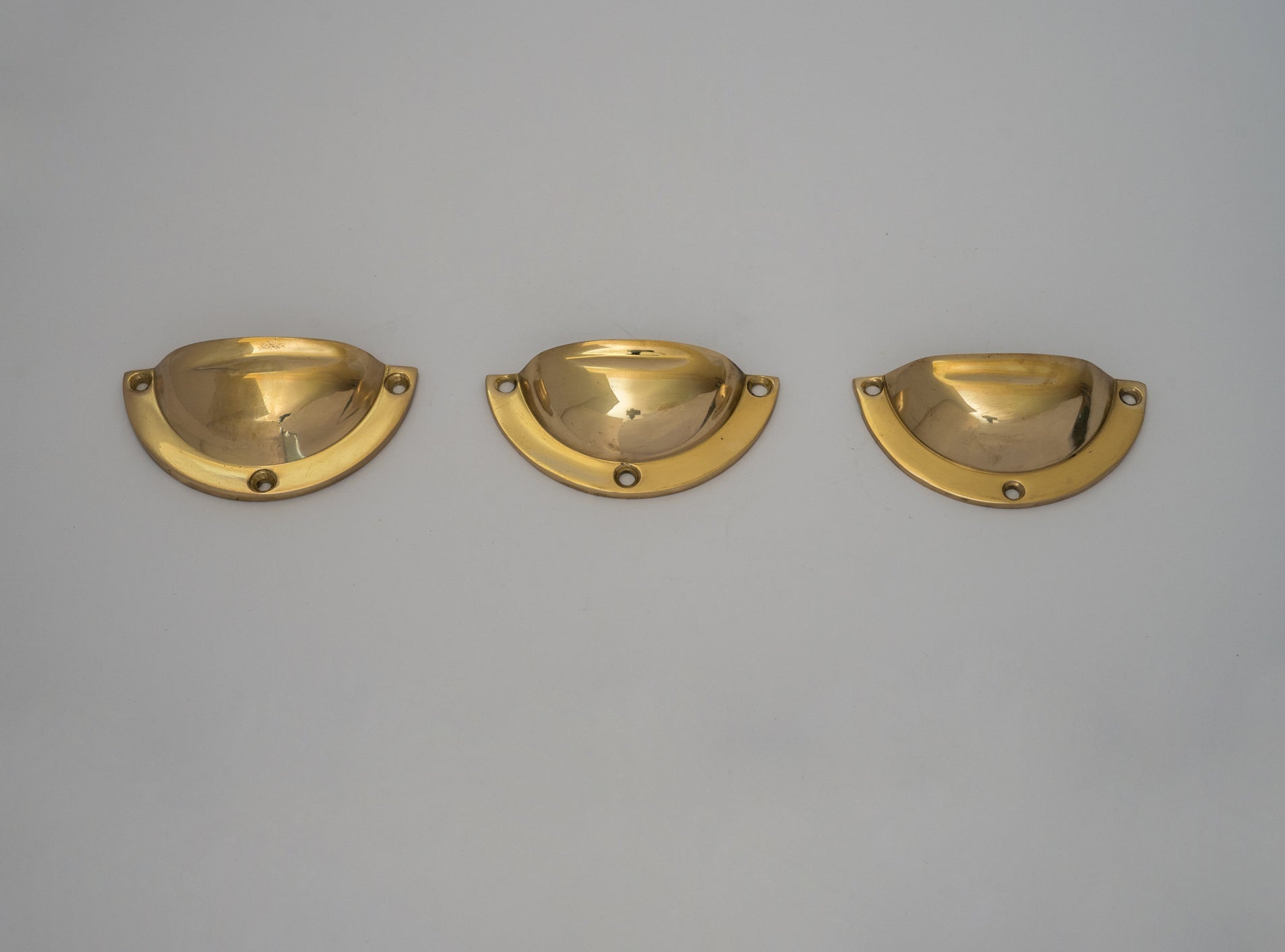
| Hardware type | Image | Best for | Grip | Visual weight |
|---|---|---|---|---|
| Knob |
|
Upper cabinets, small drawers | Fingertip | Light |
| Pull |

|
Base cabinets, wide drawers | Full hand | Medium |
A common, comfortable approach: cup knobs on upper cabinets, dresser pulls on base cabinets and drawers, all in the same unlacquered brass finish so they read as one decision rather than two separate ones.
How the finish ages on frequently-touched hardware
Unlacquered brass ages through oxidation: the bare metal reacts with air, moisture and the natural oils on skin to develop a patina, the same process that gives copper roofs their colour over decades. On a fixture that is rarely touched, that process is slow and even. On cabinet hardware, it is neither.
Because a knob or pull is gripped in the same spot dozens of times a day, the oils and friction from repeated contact slow oxidation precisely where fingers land, while the rest of the surface darkens at the normal rate. The result is a hardware piece with a brighter, burnished highlight exactly where it is held, surrounded by a deepening amber-gold patina everywhere else. This is not uneven wear or a flaw. It is the most literal version of what a living finish means: the hardware is recording exactly how your hand uses it.
What changes quickly
- The grip point develops a burnished highlight within 2 to 4 weeks of daily use
- Surrounding metal begins darkening toward amber within the first month
- Kitchen hardware patinas faster than bathroom hardware due to cooking oils and more frequent use
What stays stable
- The structural integrity of solid brass is unaffected by patina at any stage
- The two-tone grip pattern settles after 6 to 12 months rather than continuing to spread
- Green patina (verdigris) is rare on indoor hardware handled regularly, since frequent contact keeps moisture from sitting on the surface
"Powder rooms are made for drama and this one's no exception. Marble base, integrated vessel sink and a mocha plaster. This trifecta combination is giving this space life."

A working example of why this matters: in Brittany Swigart's powder room project above, the marble vanity and integrated sink anchor the room, but it is the installed brass faucet that will pick up character over the months ahead while the stone stays exactly as installed. The same logic carries over to hardware on the same vanity: any brass knob or pull added later will follow the faucet's patina timeline rather than starting from its own.
Mixing unlacquered brass with other kitchen finishes
Unlacquered brass hardware does not require an all-brass kitchen. It pairs comfortably with most cabinet colours and counter materials, and in most cases the contrast is what makes it work rather than something to avoid.
Painted cabinets
Brass hardware against painted cabinetry, whether a soft white, sage, navy or warm clay, is one of the most reliable pairings in kitchen design. Darker cabinet colours tend to make the warm gold tone of fresh brass read as a deliberate accent; lighter cabinets let the patina's deepening amber stand out more as it develops.
Natural wood and stone
Wood cabinetry and stone counters share brass's quality of ageing rather than staying static, so the three materials tend to develop a coherent, layered look together over years rather than competing for attention.
Stainless steel and chrome appliances
This is the pairing that needs the most intention. Brass hardware next to stainless appliances can look intentional and warm, or it can look like two unrelated metal tones competing, depending on how much brass is present elsewhere in the room. The safest approach is to make sure brass appears in at least one other element, a faucet, a light fixture or a hood, so the hardware reads as part of a finish family rather than an isolated accent.

A brass pot rail with S-hooks extends the same finish beyond cabinet doors into open kitchen storage.
Hooks deserve a mention here too, since they are the hardware piece most often overlooked. A wall-mounted pot rail with S-hooks, like the one above, lets the unlacquered brass finish carry into open kitchen storage, not just cabinet fronts, which helps tie the whole room together visually. The same logic extends past the kitchen: a pot filler above the range and a set of cabinet pulls below it are both high-touch unlacquered brass, and our pot filler guide covers how that fixture ages under similar daily-contact conditions.
"These are very well made, good weight, quality and great design."

Sets of hooks and knobs invite the same question buyers ask about pulls: will every piece in the set patina at the same pace? In practice, yes, because they share the same alloy and starting finish, and identical exposure to air and handling keeps them close in tone as a group.
"Beautiful hooks. Came very quickly and are great quality. Look fantastic."

Kitchen vs bathroom hardware: what's different
The hardware itself does not need to differ between rooms, but the environment changes how it behaves. Kitchen hardware patinas faster because hands are more frequently coated in cooking oils, which interact with the brass surface differently from plain skin contact. Bathroom hardware, by contrast, sees more water exposure but less oil, producing a slightly different patina character: often a touch cooler in tone and more evenly distributed since hands are typically cleaner at the point of contact.
Humidity is the other variable. A well-ventilated bathroom behaves similarly to a kitchen in terms of patina speed. A poorly ventilated bathroom, especially one without an extractor fan or window, can develop patina faster and, in rare cases, show early green spotting around the highest-moisture areas. This is the same chemistry covered in detail in our guide on whether unlacquered brass turns green, and the short version applies here too: it is uncommon, reversible, and not a sign of a defective fixture.

A single solid brass wall hook. Bathroom hardware sees more water, less oil, and a slightly cooler patina tone than kitchen hardware.
Same material, different environment
Why the same brass looks slightly different room to room
A hook by the shower and a knob on a kitchen pantry are both unlacquered brass, but the humidity, oils, and contact frequency in each room produce a visibly different patina pace and tone. Neither is more correct; they are simply two records of two different rooms.
Bathroom hardware rarely stops at one piece. A towel holder, soap dish, toothbrush holder and toilet roll holder are often bought together, and grouping them in the same unlacquered brass finish is one of the simplest ways to make a bathroom feel coordinated rather than assembled piece by piece. Insideast's holders and caddies collection covers exactly this category, towel holders, soap dishes, toothbrush holders and toilet paper holders, all in the same living finish.
"Exceptional customer service, and the pieces are really beautiful. I was putting together a Moroccan inspired bathroom and these were a stunning touch. Each piece was truly unique and bring me so much joy!"

Matching hardware to your Insideast faucets: finish cohesion
If you already have an unlacquered brass faucet from Insideast, the most reliable way to keep hardware visually consistent over time is to source it from the same workshop. Brass alloy composition varies slightly between manufacturers, which affects how quickly and toward what exact tone a piece patinas. Two unlacquered brass items from two different sources can age at noticeably different rates, even side by side in the same kitchen.
Ordering hardware and faucets together removes that variable. Both pieces start from the same alloy and the same finishing process, so a knob installed alongside a bridge faucet will deepen at a comparable pace and land on a comparable tone, rather than one piece looking noticeably further along than the other after a year.
Finish Cohesion Checklist
- Order hardware and faucets from the same workshop or supplier where possible
- Choose the same finish category (unlacquered brass, not a mix of unlacquered and antique brass) across hardware and faucets
- Install hardware and faucets around the same time so the patina clock starts together
- Expect hardware to patina faster than the faucet due to higher touch frequency, this is normal and does not mean the pieces are ageing inconsistently
- If buying hardware in stages, keep a small swatch or photo of the existing patina stage to match tone on future orders
"Statement pieces are a must in a powder room."

That same logic applies down to hardware scale. A statement faucet sets the tone for a room; matching knobs and pulls in the same finish extend that statement to every drawer and door rather than leaving it isolated to a single fixture.
Ready to match your hardware to your fixtures? Browse the hooks and knobs collection or see the full drains and hardware collection at Insideast.
Frequently Asked Questions
Common Questions About Unlacquered Brass Cabinet Hardware
Does unlacquered brass cabinet hardware patina?
How do I choose brass cabinet hardware?
What is unlacquered brass cabinet hardware?
What is the difference between cabinet pulls and cabinet knobs?
Does brass hardware work with stainless steel appliances?
The bottom line on unlacquered brass cabinet hardware
Cabinet hardware is the part of a kitchen or bathroom your hands meet the most, which makes it the fixture where a living finish tells its story fastest. The two-tone patina that develops at the grip point is not a flaw to manage. It is the most direct, personal record an unlacquered brass piece can produce: a literal map of how the space gets used every day.
Choosing between knobs, pulls and handles is mostly about matching the hardware to how each cabinet gets opened. Choosing unlacquered brass on top of that is about deciding whether you want that hardware to look exactly the same in five years, or to look like it has genuinely lived in your home. For anyone who already has Insideast fixtures elsewhere in the room, sourcing hardware from the same workshop is the simplest way to keep everything ageing on the same timeline.
See the full range of handmade hardware from the Marrakech workshop. Browse brass cabinet hardware at Insideast.


