


Latón macizo, hecho a mano en Marrakech. Explore la colección completa de fregaderos.
Lo que dicen los clientes antes de seguir leyendo
"¡Los mejores fregaderos y desagües de latón del mundo! Compramos 4 fregaderos y desagües de latón personalizados para nuestro piso principal recién renovado y ¡quedaron espectaculares! Excelente y rápido servicio al cliente."
Ambos materiales son genuinamente duraderos. Ninguno falla en una cocina normal dentro de un plazo razonable. La verdadera pregunta que se hacen los compradores es más específica: cuál sigue luciendo bien después de una década de uso diario, no solo cuál sobrevive. La respuesta depende completamente de lo que se espere de un fregadero a medida que envejece.
- Ambos materiales suelen durar entre 20 y más de 30 años en uso residencial. La vida útil no es realmente el factor diferenciador.
- El acero inoxidable mantiene su aspecto visual inalterado durante toda su vida útil. El latón macizo cambia, desarrollando una pátina que la mayoría de los propietarios llegan a preferir sobre el acabado original.
- El acero inoxidable resiste mejor las abolladuras. El latón resiste mejor la corrosión y nunca se oxida.
- El mantenimiento es aproximadamente igual: unos pocos minutos a la semana para cualquiera de los materiales, solo que se gestionan diferentes aspectos.
- El peso es la verificación de calidad más sencilla para ambos materiales: un fregadero de acero inoxidable de calibre delgado se flexiona y resuena, uno de latón macizo no.
La diferencia fundamental de material
El acero inoxidable es una aleación de hierro, cromo y níquel. El cromo forma una capa de óxido invisible en la superficie que resiste la oxidación y mantiene el metal con un aspecto esencialmente idéntico desde el día en que se instala hasta el día en que se retira. Esa estabilidad es el objetivo principal del material.
El latón macizo es una aleación de cobre y zinc. Sin lacar, la superficie reacciona al aire, al agua y al manejo. Esto no es un defecto en el metal. Es el comportamiento previsto de un acabado sin lacar. Con el paso de los meses y los años, se oscurece de un oro brillante a tonos ámbar, marrón y bronce más profundos, un proceso que se detalla en nuestra guía sobre cómo envejece el latón sin lacar.
Ninguna reacción es mejor en abstracto. El acero inoxidable está diseñado para resistir el cambio. El latón, sin lacar, permite mostrarlo. Cuál de los dos quieras depende de si un fregadero que muestra 10 años de uso te parece desgaste o carácter.
Durabilidad: resistencia a arañazos, abolladuras y manchas, comparada honestamente
| Factor | Acero Inoxidable | Latón Macizo (sin lacar) |
|---|---|---|
| Arañazos | Visibles permanentemente; sin mecanismo de autorreparación | Se integran en la pátina en desarrollo en cuestión de semanas |
| Abolladuras | Los fregaderos de calibre delgado pueden abollarse con un impacto fuerte | El latón macizo resiste las abolladuras debido a su masa y densidad |
| Óxido / corrosión | Resistente, pero puede picarse u oxidarse en los arañazos con el tiempo en calidades bajas | Nunca se oxida; el latón no contiene hierro |
| Manchas de agua | Se muestran claramente en la superficie reflectante | Impacto visible mínimo una vez que la pátina se ha desarrollado |
| Manchas ácidas | Generalmente resistente | Puede aclarar la pátina localmente; se recupera con el uso normal |
La cuestión de las abolladuras se reduce casi por completo al calibre y la masa, no solo a la categoría del material. Un fregadero de acero inoxidable de calibre 18 delgado se abollará si se cae una olla de hierro fundido. Un fregadero de latón macizo, fundido y mecanizado en lugar de prensado de chapa, tiene mucha más masa para absorber el mismo impacto. Levántelo antes de comprar, si puede. El peso es la señal más rápida y honesta de cómo resistirá cualquier accesorio de latón macizo con el tiempo.

La prueba que siempre funciona
Levántalo antes de comprarlo.
Un fregadero de latón macizo tiene un peso notable. Los fregaderos delgados de acero inoxidable se sienten ligeros y pueden sonar huecos al golpearlos. Un fregadero de acero inoxidable de calibre pesado y de calidad también se sentirá sustancial, por lo que el peso no es una prueba de lealtad a la marca, es una prueba de calidad de fabricación que se aplica a ambos materiales por igual.
Mantenimiento: cuál es realmente más fácil en el día a día
El acero inoxidable necesita una limpieza regular para evitar manchas de agua y marcas de dedos en su superficie reflectante, además del uso ocasional de un limpiador específico para acero inoxidable para mantener el brillo original. Omitir esto no daña el fregadero, simplemente se verá con manchas.
El latón sin lacar necesita una limpieza rápida similar después de usarlo, además de un lavado ocasional con jabón suave y agua tibia, detallado completamente en Cómo limpiar latón: ¡Probamos 5 métodos efectivos y fáciles para usted!. La única restricción real: evite la lejía, el amoníaco y los estropajos abrasivos, que pueden eliminar la pátina de manera desigual. Ninguno de los fregaderos exige más de unos pocos minutos a la semana bajo un uso doméstico normal. La diferencia es para qué se mantiene: el acero inoxidable para la uniformidad, el latón para un aspecto evolutivo.
"Este es un hermoso recipiente, la comunicación fue excelente durante todo el proceso, manteniéndome al tanto de los tiempos. También una muy buena conversación sobre cómo el cobre cambia de color, cómo cuidarlo y el uso general del producto. Lo recomiendo encarecidamente."

Conversaciones como esta son exactamente lo que el equipo de Insideast hace en cada pedido: guiar a los compradores sobre cómo cambiará el metal, qué esperar en los primeros meses y cómo cuidarlo una vez que llegue. Esa misma guía está escrita en su totalidad en nuestra Guía de cómo cambia el metal y cómo cuidarlo, para que nunca tenga que adivinar una vez que el fregadero esté instalado.
Estética: cuál envejece mejor en 10 años
Aquí es donde los dos materiales divergen genuinamente, y es la parte que la mayoría del contenido comparativo pasa por alto. Un fregadero de acero inoxidable en el año 10 se ve como una versión ligeramente desgastada de sí mismo en el año uno: arañazos finos visibles que se acumulan y nunca desaparecen, un brillo más opaco que cuando era nuevo, el mismo color y carácter esencial en todo momento.
Un fregadero de latón macizo en el año 10 luce significativamente diferente al del año uno, y la mayoría de los propietarios describen esa diferencia como una mejora. La superficie se oscurece de un oro brillante a tonos ámbar, marrón y bronce ricos con una profundidad y variación genuinas, la misma calidad de acabado vivo descrita en nuestra guía sobre latón lacado vs. sin lacar. No hay dos fregaderos de latón que envejezcan idénticamente, porque la pátina responde a la química del agua y a los patrones de uso específicos.
"Me encanta cómo esta cómoda de roble del siglo XIX, un hermoso fregadero de latón artesanal y un grifo a juego crearon mi tocador de baño único. Gracias por ofrecer estas piezas de arte de latón hechas a mano. Excelente comunicación y envío."
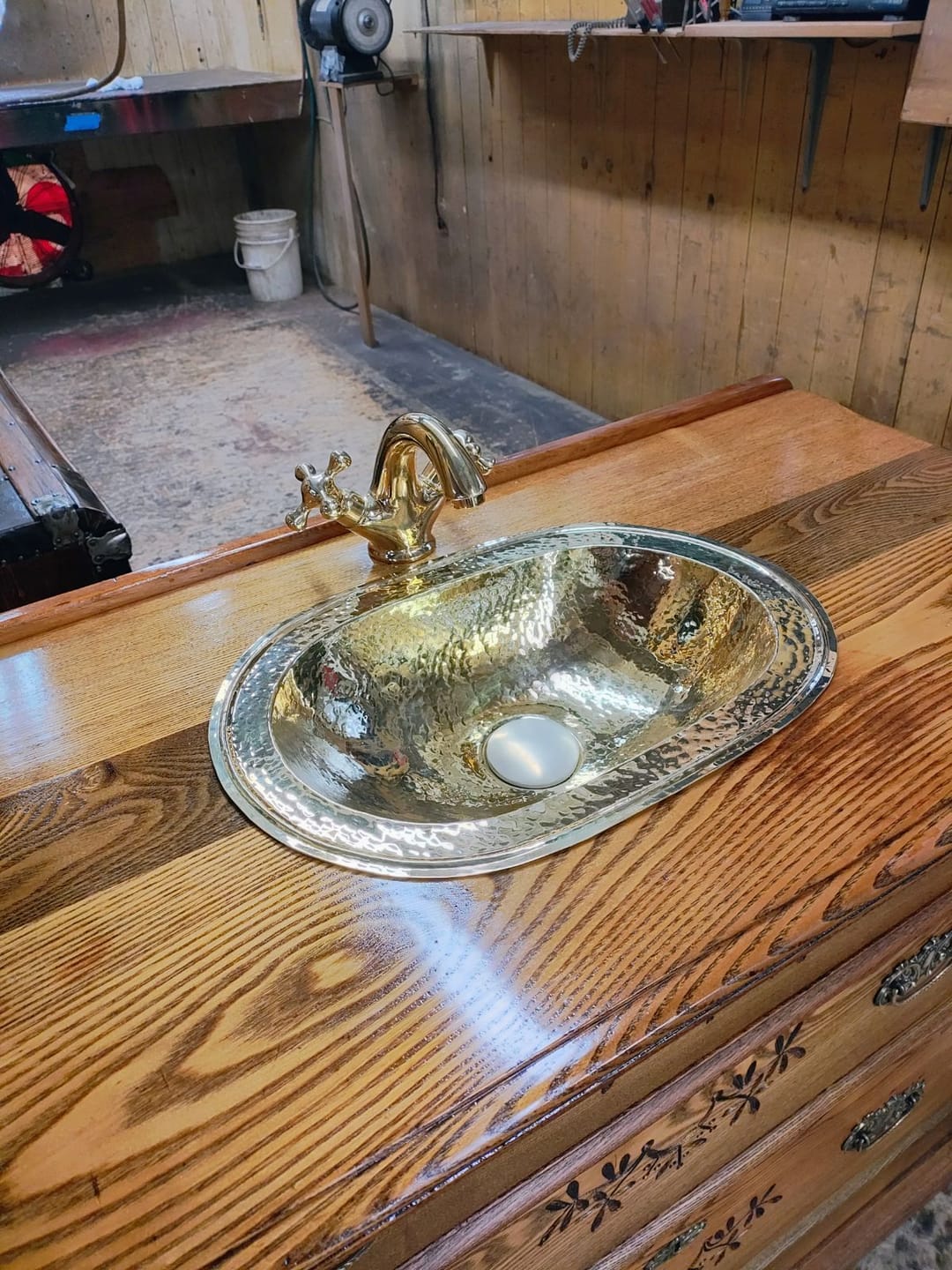
Lo que el acero inoxidable nunca puede hacer es desarrollar carácter. Está diseñado específicamente para resistir este tipo de cambio. Esa es una ventaja genuina si la consistencia es lo que buscas en un fregadero. Es una limitación genuina si esperas que el fregadero se vea mejor, no solo igual, después de una década de uso.
Costo real a lo largo del tiempo, no solo el precio de compra
El precio de compra varía enormemente dentro de cada categoría, dependiendo del calibre, la marca y si el latón es macizo o chapado. Una comparación justa debe ir más allá del precio de etiqueta para ver lo que cada material realmente le cuesta a lo largo de su vida útil.
Costos del acero inoxidable
- Precio de entrada típico más bajo para modelos de calibre delgado
- Los arañazos visibles son permanentes; no hay opción de restauración
- El valor de reventa o reemplazo disminuye una vez que está rayado o opaco
- No hay costos continuos más allá de los suministros básicos de limpieza
Costos del latón macizo
- Precio de entrada típico más alto, que refleja el metal macizo y la construcción artesanal
- Las marcas y el desgaste ligero se absorben en la pátina en lugar de perder valor
- Un pulido de latón puede restaurar completamente el acabado original en cualquier momento, reversible sin costo real
- El precio directo de fábrica reduce la brecha frente al latón de casas de diseño comparables
El detalle que cambia el cálculo: el desgaste del acero inoxidable es una pérdida unidireccional. El desgaste del latón es reversible y, si se deja solo, se convierte en parte de lo que la gente realmente paga. Esa es la asimetría central entre los dos materiales durante un período de propiedad de 10 años.
Recomendación honesta para cada escenario
Elija acero inoxidable si su cocina tiene un uso comercial intensivo, si desea cero cambios visuales con el tiempo, o si trabaja con un presupuesto ajustado y necesita un fregadero fiable y de bajo mantenimiento.
Elija latón macizo si el fregadero es también un elemento de diseño en la habitación, le atrae la calidez de un acabado vivo que envejece junto con otros detalles de latón sin lacar en su cocina, y se siente cómodo con unos minutos de cuidado semanal a cambio de un fregadero que mejora en lugar de simplemente sobrevivir.
Muchos de nuestros clientes optan por una solución intermedia: un fregadero de preparación de acero inoxidable en una zona de trabajo secundaria y un fregadero principal de latón macizo donde se ve y se usa a diario. Ambas opciones son razonables. Ninguna es incorrecta. La respuesta honesta a "¿cuál dura más?" es que ambos duran décadas; la verdadera pregunta es qué tipo de década desea ver.
La alternativa de instalación
El latón bajo encimera envejece de la misma manera
El argumento de la pátina se mantiene independientemente del estilo de instalación. Un fregadero de latón macizo bajo encimera desarrolla el mismo acabado vivo que cualquier otro lavabo de latón sin lacar, y muchos de los mismos argumentos de durabilidad contra el acero inoxidable se aplican igualmente aquí, ya sea que el lavabo se encuentre en una barra de isla de cocina o en una zona de preparación principal. Si aún está decidiendo sobre el tipo de instalación, nuestra guía de fregaderos de latón bajo encimera vs. empotrados cubre esa elección en su totalidad.

"Qué maravilla. Contemplar una artesanía tan fina es como admirar una obra de arte, y cada vez que te detienes en este lavabo de tocador y grifo de puente, caes bajo su hechizo."
Esa reacción, tratar un fregadero y un grifo como una pieza que merece la pena contemplar en lugar de solo un accesorio, es el argumento estético del latón en una sola frase. También es la razón por la que tantos de nuestros clientes fotografían sus fregaderos años después de la instalación: la pátina se convierte en parte de la historia de la habitación, algo que un lavabo de acero inoxidable nunca ofrece.
Preguntas Frecuentes
¿Es mejor un fregadero de latón que uno de acero inoxidable?
¿Se raya el latón más fácilmente que el acero inoxidable?
¿Cuánto dura un fregadero de latón?
¿Es mejor el latón o el acero inoxidable para un fregadero de cocina?
¿Los fregaderos de latón necesitan más mantenimiento que los de acero inoxidable?
Cada fregadero de Insideast está hecho a mano en nuestro taller de Marrakech con latón macizo, no zinc chapado, y se envía a todo el mundo con una garantía de 5 años y una guía de instalación impresa. Explore la colección completa de fregaderos para comparar estilos y pesos con lo que tenga en mente.


