


Handcrafted solid brass undermount sink, 19-gauge, hammered finish. Made in Marrakech.
"Contemplating fine craftsmanship is like admiring a work of art. Every time you linger over this vessel sink and bridge faucet, you fall under its spell." That was a French vacation rental owner, writing about the brass sink and bridge faucet she ordered from Marrakech. It is not the kind of thing people say about a stainless steel basin.
Brass kitchen sinks have been back for several years now, and the interest has not faded. What has changed is who is buying them and why. Early adopters were mostly design-forward renovators who wanted something different from stainless. Now the buyer is more likely to have spent real time researching: reading reviews, watching installation videos, asking about patina, drain compatibility, and whether solid brass is actually worth the premium over brass-plated alternatives.
This guide answers those questions directly. It is written for UK buyers specifically, which means it addresses British kitchen sizing conventions, hard water, and what to expect from international ordering. Most of what you will find online is written for the US market. This is not.
The short version: a solid brass kitchen sink is one of the most durable things you can put in a kitchen. The details matter enormously. Here is what to know before buying.
- Solid brass (19-gauge or thicker) is structurally different from brass-plated stainless or zinc, the material goes all the way through
- Hammered texture is structural as well as aesthetic: it reinforces the panel against flexing
- Undermount installation looks cleaner and is more hygienic; drop-in is easier to retrofit
- Compatible with standard UK 90mm and US 1.5" / 2" waste fittings, confirm before ordering if your plumbing is non-standard
- A brass kitchen sink develops patina like any unlacquered brass fixture, faster on the basin floor, slower on the sides
- Factory-direct from Marrakech means no retail markup: comparable sinks from British premium brands cost 2 to 3 times more
Why Brass Kitchen Sinks Are Back
The return of brass in UK kitchens is part of a longer material story. Stainless steel dominated for thirty years because it was affordable, neutral, and easy to specify. Then the market split. High-end kitchen design moved toward materials with more presence: stone, copper, unlacquered brass, handmade ceramic. Brass sinks arrived with that wave and have stayed because they do something stainless cannot: they improve with age.
An unlacquered brass sink develops a patina the same way an unlacquered brass faucet does. The basin floor, which gets the most water contact and mechanical action, darkens fastest. The sides change more slowly. After two or three years, a regularly used brass sink has a warmth and depth that no new sink can replicate. It reads as genuinely old in the best possible sense.
The British market has embraced this more quickly than most. The deVOL effect is real: UK buyers have been trained by a decade of handmade kitchen content to expect artisan materials at a premium price. The gap that Insideast fills is the same material quality at a factory-direct price, because the sinks are made in Marrakech and shipped without a retailer's margin added. If you are weighing brass against the material it most often replaces, the full brass sink vs stainless steel comparison covers durability and long-term cost side by side.
Every year it looks more itself
The basin floor darkens first, that is where water sits longest and where hands reach most. The walls change more slowly. By year three, the gradient between base and rim becomes part of what makes the sink unmistakably handmade.

Undermount vs Drop-In Installation
This is the first practical decision most buyers face, and it affects both the installation process and how the sink looks in daily use.
Undermount
- Sits below the countertop, held by clips and silicone
- Countertop edge is fully exposed, cleaner look
- Water and crumbs wipe directly into the basin
- More hygienic: no rim to trap debris
- Requires stone, solid wood, or Corian worktop
- Needs a plumber for most installs
Drop-In (Top-Mount)
- Sits into a cut hole, rim rests on worktop surface
- Easier retrofit into existing worktops
- Works with laminate, tile, and solid surfaces
- Rim can accumulate water and debris over time
- More visible from above, the rim becomes part of the design
- DIY-friendlier installation
For UK kitchens, the choice often comes down to worktop material. If you have a stone worktop (granite, marble, quartzite, engineered stone), undermount is almost always the right call. The edge detail on an undermount installation is one of the things that makes a brass sink look properly finished rather than retrofitted. If you have a timber or laminate worktop, drop-in is usually more practical and preserves the worktop integrity better. For a closer look at how each style handles cleaning, countertop pairing, and installation cost, see the full undermount vs drop-in installation guide.
The hammered undermount brass sink from Insideast uses standard undermount installation with silicone and mounting clips, compatible with stone and solid surface worktops. Custom dimensions are available on request, which is relevant in UK kitchens where Belfast sink openings and non-standard cutouts are common.
Hammered vs Smooth Brass: What the Texture Means
Hammered texture on a brass sink is not purely decorative. The process of hammering a flat brass sheet work-hardens the metal at each strike point, creating a surface that is structurally stiffer than a smooth panel of the same gauge. On a 19-gauge brass sheet (approximately 1mm thick), hammering significantly reduces the risk of oil-canning, the slight flexing you can get from large flat metal panels under load or temperature change.
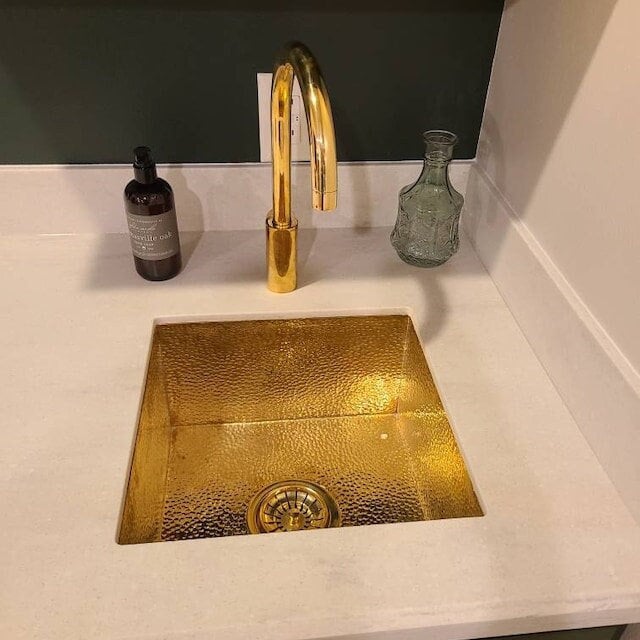
Structurally stronger and visually richer
Each hammer mark work-hardens the brass at that point, making the panel stiffer overall. The texture also catches light differently at different angles, giving the sink a depth that flat brass cannot achieve. The 19-gauge construction means the edges resist bending during installation.
The practical difference in daily use is also notable. A hammered surface is more forgiving of water spots and minor surface marks than a smooth polished brass. The texture breaks up the visual uniformity of a surface, so small scratches or water residue are far less visible. For a kitchen sink that gets heavy daily use, this is a real advantage.
Smooth brass sinks exist and suit certain kitchen aesthetics, particularly more formal or minimalist spaces. But in a working kitchen, hammered brass is the more practical and more resilient choice.
My copper sink is exactly as I wanted! Abdel wanted me to be very happy and he made that happen. His communication with me let me know where we were in the process of making the sink. There are plenty of solid brass sinks and faucets, along with copper in his shops. Thank you Abdel!

Solid Brass vs Brass-Plated: How to Tell Before You Buy
This is where most buyers go wrong. The word "brass" on a product listing can mean three very different things: solid brass throughout, brass-plated stainless steel, or brass-plated zinc alloy. Only the first one ages, develops patina, and lasts for decades. The other two eventually chip, corrode at the edges, or peel in ways that cannot be repaired. The same distinction applies to faucets and fixtures: the full comparison of lacquered vs unlacquered brass covers what each finish means for long-term performance.
| Type | What It Is | Lifespan | Patina |
|---|---|---|---|
| Solid brass | Brass alloy (copper + zinc) throughout the full thickness | 20 to 50+ years | Develops naturally, improves over time |
| Brass-plated stainless | Stainless steel base with thin brass electroplating | 5 to 15 years | Plating chips or wears through; patina not possible |
| Brass-plated zinc | Zinc alloy base with thin brass electroplating | 3 to 10 years | Corrodes at scratches or edges; no real patina |
Three tests that work before you buy. First, check the weight specification: solid brass is heavy. An 18 x 18 inch solid brass sink should weigh 8 to 12 kilograms. If a listing shows no weight or an implausibly low number, it is likely plated. Second, check the gauge: solid brass sinks state gauge (16, 18, or 19). Plated products rarely do. Third, read the returns policy carefully: sellers of plated products almost never offer long warranties because the product cannot support them.
Insideast states gauge on every sink product page. The hammered kitchen sink is 19-gauge solid brass. That is the actual number; there is no plating involved.
For UK buyers, brass plumbing fittings and fixtures used in contact with drinking water are also subject to WRAS (Water Regulations Advisory Scheme) approval requirements. Solid brass is an approved material under these regulations; brass-plated zinc is not. This is one more practical reason the solid vs plated distinction matters for UK kitchen installations specifically.

"Bought the same item again in a larger size"
Solid brass confirms itself on delivery. When the dimensions are true to spec and the gauge is what was described, a repeat purchase is the clearest possible endorsement.
"Beautiful workmanship. Sink basin was true to size. Bought the same item again in a larger size for a different bathroom."
Rebecca, Etsy verified purchase, April 2026
Will a Brass Kitchen Sink Scratch, Stain, or Dent?
These are the three questions most UK buyers ask before committing, and they deserve direct answers. For a side-by-side look at how brass holds up against the most common kitchen sink material over the long term, the brass vs stainless steel durability comparison goes deeper on this exact question.
Scratches: Yes, unlacquered brass scratches more easily than stainless steel. A metal pot dragged across the basin will leave a mark. In practice, this matters less than buyers expect because brass scratches blend into the developing patina within weeks. The scratch does not expose a different material underneath (as it would on a plated sink); it simply marks the brass surface, which continues to age uniformly. By year two, surface marks become part of the texture rather than a visible defect.
Staining: Hard water deposits are the most common issue in UK kitchens, particularly in regions where water hardness exceeds 200 mg/L (most of the South East, East Midlands, and East of England). Calcium deposits appear as white or grey haze on the basin floor. They are removed with a dilute solution of white vinegar or lemon juice and a soft cloth. Do not use CLR, Bar Keepers Friend, or any chlorine-based cleaner: these strip the natural patina unevenly and can pit the surface.
Dents: A 19-gauge solid brass sink is resistant to denting under normal kitchen use. The hammered construction makes it stiffer still. Heavy cast iron pans dropped from height could leave a mark, but this is not a realistic daily-use scenario. The gauge is thick enough that the sink will not flex or resonate when you set items down, which is the main acoustic complaint about thin stainless sinks.
"The brass will become dull over time"
Gabriele noticed her sink arrived polished. After speaking with the team, she understood the finish would settle into its natural unlacquered state over time. That transparency is exactly what buying an unlacquered brass sink requires.
"Everything was great! Very nice sink! The brass is polished; I spoke to the seller, who explained that it will become dull over time. Thank you so much!"
Gabriele, Etsy verified purchase, April 2026

Brass Sink and Tap Pairing for UK Kitchens
The most important rule for pairing a brass sink with taps is finish consistency. Unlacquered brass ages; lacquered brass and brass-effect chrome do not. If you pair a solid unlacquered brass sink with lacquered brass taps, the taps will stay static while the sink darkens and warms. Within two years, they will look like different metals.
The cleanest solution is to source sink and taps from the same workshop. When both are made from the same brass alloy in the same Marrakech workshop, they develop patina at the same rate and read as a coherent matched set over time. This is the principle behind the bridge faucet and sink pairings that have driven the most well-executed kitchen renovations using Insideast products.

Best paired with the Heritage or Verdeau bridge faucet. The hammered texture echoes the hand-forged quality of the faucet body. Suits stone worktops.

Drop-in format, suited to kitchen islands or prep stations. The decorative etching pairs well with more ornate kitchen hardware and cross-handle faucets.

33-inch single bowl, apron-front format. Suits traditional British kitchen cabinetry and pairs naturally with a gooseneck bridge faucet for deep-basin clearance.
For UK plumbing specifically: Insideast taps ship with standard fittings, and BSP (British Standard Pipe) configurations are available on request. Confirm your preferred fitting when ordering, or contact contact@insideast.com before placing an order if you are unsure. This takes one message and usually resolves within a few hours.
"The sink faucet, shower handles, and shower head are all from @insideastdesigns, and I love how they look."

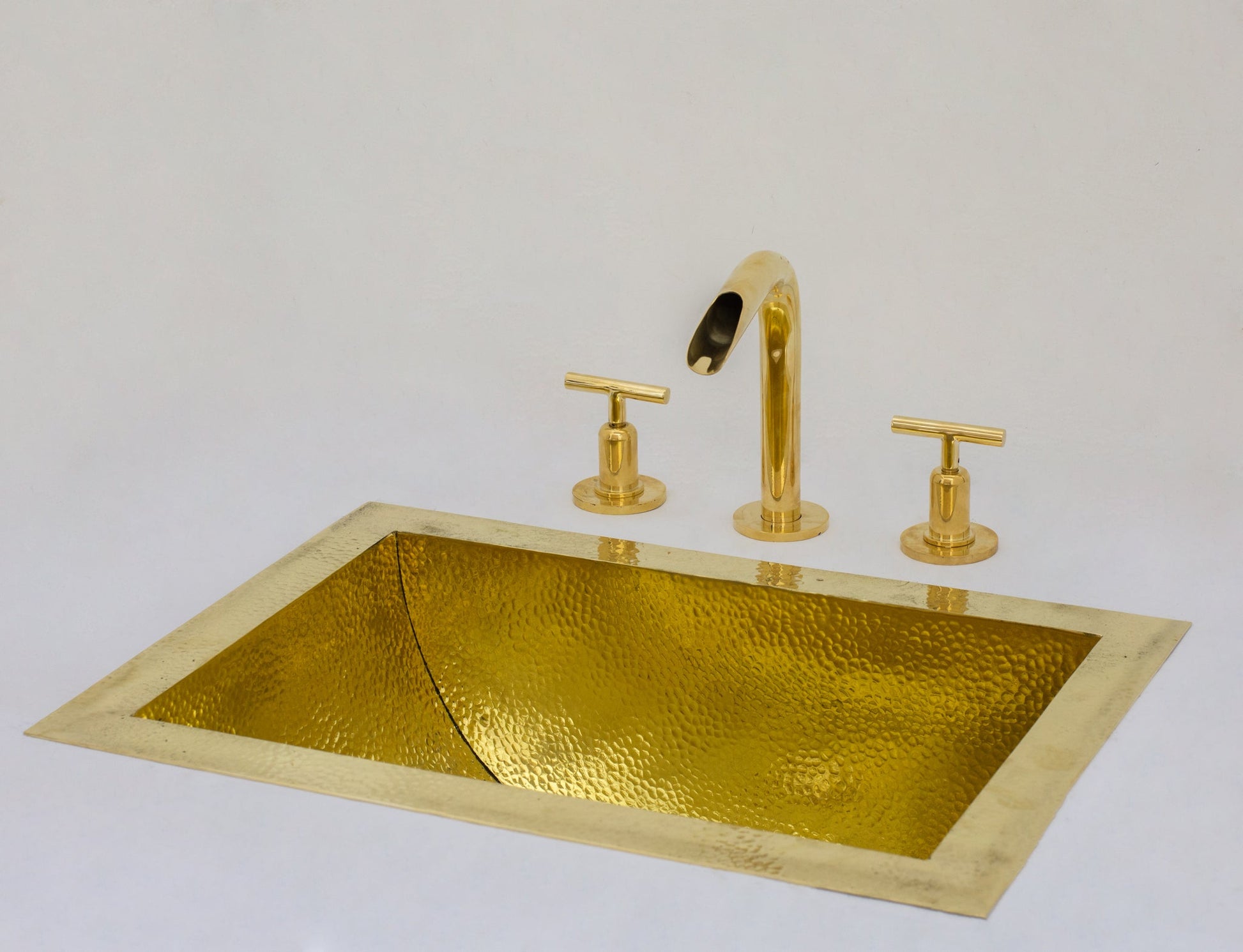
When the sink is the centrepiece of the room
The deep curved basin in solid hammered brass sits level with the stone surface, no rim visible. The 3-hole waterfall faucet mounts directly on the countertop. Both pieces sourced from the same workshop, aging together from day one.
Price Guide: Factory-Direct vs Retail Markup
The price of a solid brass kitchen sink in the UK varies by roughly 200 to 300% depending on where it is purchased. The material and construction quality can be identical. The difference is entirely the retail and distribution markup applied by the time a product reaches a British showroom.
Solid brass, handmade in Marrakech, shipped direct. Starts at $128 (approx. £100) for standard sizes; custom dimensions, large formats, and specialist finishes scale from there. No retail margin.
Often the same Moroccan-made product with a UK distributor margin applied. Some are genuinely premium British-made; most are not.
deVOL, Perrin & Rowe, and similar. Genuinely British-made in many cases, with brand premium. Different buyer proposition entirely.
One UK buyer left a note worth reading for anyone nervous about international ordering: "Sinks arrived in good time and look amazing. I did have to pay around £100 import duty on arrival, but everything else has been great. Can't wait to get them in my new kitchen." The import duty note is honest and worth flagging. For orders above the UK customs threshold, import duty may apply depending on declared value and category. Contact Insideast before ordering if you want a precise estimate for your order size.
The overall value picture is straightforward: for a sink that will be in your kitchen for 20 or 30 years, the difference between a £300 factory-direct price and a £700 retail price compounds significantly. What you are paying at the higher price is not better brass. It is showroom rent, distribution margin, and brand overhead.
If you are planning to pair your sink with an unlacquered brass bridge faucet, the kitchen faucet style guide covers Heritage, Verdeau, and Bridgeford in detail. For care and maintenance of unlacquered brass surfaces generally, see the living finish guide. And if installation style is still the open question, the undermount vs drop-in guide walks through countertop pairing and cost in full.
Frequently Asked Questions
Common Questions About Brass Kitchen Sinks
Are brass kitchen sinks any good?
Solid brass kitchen sinks are among the most durable sink materials available, provided the sink is genuine solid brass and not brass-plated. A 19-gauge solid brass sink will outlast most stainless steel sinks and every brass-plated alternative. The practical advantages are structural rigidity, resistance to corrosion, and a surface that improves in appearance over time rather than looking worse with use. The practical disadvantages are weight (which can affect cabinetry requirements), sensitivity to harsh chemical cleaners, and a surface that scratches more visibly than stainless in the short term. Most buyers who do their research before purchasing consider these trade-offs acceptable given the long-term outcome.
How do you maintain a brass kitchen sink in the UK?
Daily maintenance requires nothing more than rinsing the basin and wiping with a soft cloth after use. For UK hard water deposits, a dilute solution of white vinegar (one part vinegar to four parts water) applied with a soft cloth removes calcium build-up without affecting the patina. Monthly, a light wipe with a small amount of olive oil or beeswax cream helps protect the developing patina layer. Never use bleach, chlorine-based cleaners, steel wool, or abrasive pads: these either strip the patina unevenly or scratch the brass surface in ways that take months to blend back in.
Do brass kitchen sinks scratch easily?
Brass scratches more easily than stainless steel under direct metal-on-metal contact. In a kitchen environment this means dragging a metal pot or utensil across the basin will leave a visible mark. However, because solid brass scratches through the same material rather than through a plating layer, the mark blends into the developing patina within weeks. By the end of the first year of use, surface marks become essentially invisible within the broader patina texture. The scratching concern is more relevant in the first few months of ownership, before the patina establishes itself.
Are brass sinks worth it?
For buyers who want a kitchen that looks better in ten years than it does on installation day, solid brass is worth it. The material appreciates visually in a way that stainless steel, ceramic, and composite sinks do not. It is also one of the few sink materials that is genuinely antimicrobial: brass is naturally resistant to bacterial growth, which matters in a food preparation environment. The value case is strongest when buying factory-direct, where the price reflects manufacturing cost rather than retail overhead. At a factory-direct price starting from around £100, a solid brass sink is a reasonable premium over a mid-range stainless alternative, and the gap in long-term outcome is significant.
Does Insideast ship brass kitchen sinks to the UK?
Yes. Insideast ships to the UK with standard international tracked shipping. Production takes 5 to 10 business days per sink, as each piece is handcrafted individually. Import duty may apply for orders above the UK customs threshold; contact Insideast before ordering if you want a precise estimate. BSP fittings for UK waste connections are available on request. Most UK installations are straightforward, but if you have a non-standard under-sink configuration (particularly in Belfast-sink cabinetry), confirm drain compatibility before ordering by emailing contact@insideast.com.
Will my brass sink turn green?
In normal UK kitchen use, green patina (verdigris) on a brass sink is uncommon. Verdigris forms when brass is exposed to moisture combined with acidic compounds or certain chemicals over extended periods. A kitchen basin that is rinsed and dried regularly does not typically develop green patina. The areas most likely to see colour change are the basin floor and drain surround, where water sits longest. These areas darken to a warm brown rather than green. If green patina does appear, it is removed with lemon juice and a soft cloth and is not permanent damage. For a detailed explanation of the full patina process, see our guide on whether unlacquered brass turns green.
Every Insideast brass sink is handcrafted in Marrakech, made to order, and shipped direct with no retail markup. Custom dimensions are available for non-standard cutouts. Browse brass kitchen sinks or view the full sink collection including bathroom and vessel styles.


