


Fabriqué à la main dans l'atelier Insideast à Marrakech. Découvrez la collection complète de suspensions.
Une suspension en laiton ou en cuivre au-dessus d'un îlot de cuisine est l'une de ces décisions qui, soit démodent une cuisine en cinq ans, soit la définissent pour vingt. La différence réside presque entièrement dans la finition. Le laiton poli avec un revêtement de laque aura exactement le même aspect année après année jusqu'à ce que la laque s'écaille ou jaunisse. Le laiton non laqué et le cuivre massif font le contraire : ils commencent chauds et deviennent plus riches, plus foncés et plus caractéristiques avec le temps. La suspension que vous installez aujourd'hui aura un aspect nettement meilleur dans trois ans que le jour de son arrivée.
Ce guide couvre tout ce dont vous avez besoin pour choisir en toute confiance : la forme et comment elle affecte l'apparence de votre cuisine, la différence réelle entre le laiton et le cuivre, comment les finitions vieillies, antiques et non laquées se comparent, les options de suspension et les longueurs de cordon, ainsi que les chiffres de taille et de hauteur de suspension pour les îlots de cuisine de toute longueur.
- Le laiton vieilli, le laiton antique et le laiton non laqué sont des finitions différentes avec des comportements à long terme différents. La terminologie est importante avant d'acheter.
- Les suspensions dôme dirigent la lumière vers le plan de travail. La forme convient aux îlots de cuisine utilisés à la fois comme espace de travail et surface sociale.
- Hauteur de suspension pour les suspensions d'îlot de cuisine : 70 à 90 cm entre la base de la suspension et la surface du plan de travail.
- Les suspensions vieillissent plus lentement que les robinets car elles ne sont presque pas directement manipulées. Attendez-vous à un changement progressif et subtil plutôt qu'à une patine rapide.
- Les suspensions Insideast sont disponibles avec quatre types de suspension et des longueurs de cordon personnalisées, spécifiées lors de la commande.
- Pourquoi les suspensions en laiton et en cuivre trouvent leur place dans les cuisines françaises
- Dôme, globe et cylindre : quelle forme pour quelle cuisine
- Laiton martelé vs cuivre oxydé : comparaison des matériaux
- Laiton vieilli, antique et non laqué : ce que chaque finition signifie réellement
- Guide de taille et de hauteur de suspension pour les îlots de cuisine
- Options de suspension et longueurs de cordon
- Suspension unique vs groupe : règles d'espacement
- La finition d'une suspension vieillit-elle comme un robinet ?
- Questions fréquemment posées
Pourquoi les suspensions en laiton et en cuivre trouvent leur place dans les cuisines françaises
Le design des cuisines françaises s'est résolument orienté vers les matériaux naturels au cours de la dernière décennie. Les carreaux Zellige faits à la main, les plans de travail en pierre, les robinets en laiton non laqué, les armoires en bois vieilli : tous partagent une qualité commune, à savoir qu'ils sont plus beaux usés que neufs. Les suspensions en laiton et en cuivre appartiennent à cette catégorie. Ce ne sont pas simplement des options métalliques aux tons chauds dans un catalogue d'éclairage. Ce sont des matériaux avec une trajectoire de patine, et la finition que vous voyez le jour de l'installation n'est pas le résultat final.
Le marché reflète ce changement. Le terme de recherche "suspension laiton" reçoit environ 1 600 recherches mensuelles en France, avec "suspension laiton vieilli" et "suspension laiton antique" générant chacune environ 880 recherches mensuelles en France. Ce sont des acheteurs qui ne recherchent pas une finition métallique chaude générique. Ils recherchent spécifiquement la qualité vieillie et vivante qui distingue ces matériaux des alternatives en chrome ou en noir mat.
Le cas pratique est tout aussi solide. Une suspension dôme au-dessus d'un îlot de cuisine concentre la lumière vers le bas sur la surface du plan de travail, ce qui est utile pour la préparation des aliments. La chaleur matérielle du laiton ou du cuivre modifie également la façon dont la couleur de la lumière est perçue dans la pièce : l'intérieur d'un dôme en laiton ou en cuivre ajoute une touche chaude à la lumière qu'il reflète, nettement différente d'un abat-jour peint ou thermolaqué.
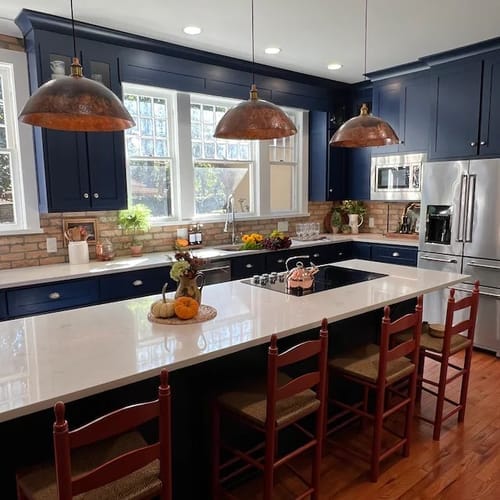
"Magnifiquement fait. Véritable cuivre. Ajoute de la chaleur et de la texture au-dessus de notre îlot de cuisine."
Dôme, globe et cylindre : quelle forme pour quelle cuisine
Les trois formes de suspensions les plus courantes pour les îlots de cuisine créent chacune un caractère visuel différent dans la pièce. Le choix porte en partie sur la direction de la lumière, mais plus important encore sur la façon dont la suspension est perçue depuis l'autre côté de la cuisine et comment elle s'intègre au style général.
Suspension dôme
La forme la plus courante pour les îlots de cuisine. Le dessus fermé et la base ouverte concentrent la lumière vers le bas sur le plan de travail. Forte présence visuelle. Fonctionne comme un point focal délibéré. Convient aux styles de cuisine ferme, méditerranéen, industriel et artisanal. La forme que l'atelier Insideast fabrique en laiton et en cuivre.
Suspension globe
Une sphère fermée, généralement avec une ampoule visible. La forme crée un effet plus doux et plus ambiant. Convient bien lorsque l'îlot est principalement une surface sociale plutôt qu'un espace de travail de préparation. Convient aux cuisines scandinaves, du milieu du siècle et de transition. Moins directionnelle qu'un dôme.
Suspension cylindre
Un abat-jour droit avec un profil géométrique épuré. Présence visuelle plus discrète qu'un dôme. Convient bien aux cuisines contemporaines et minimalistes. Moins caractéristique en tant que forme, ce qui signifie que le matériau fait moins le travail que dans un dôme ou un globe.
Que choisir
Pour les cuisines avec des carreaux faits main, de la pierre ou des matériaux naturels, les suspensions dôme semblent les plus cohérentes avec le langage matériel général. Le laiton et le cuivre sont des matériaux de caractère. Une forme de dôme donne à ce caractère l'expression la plus visible.

Suspension Dôme Laiton Antique Patiné au-dessus d'un îlot de cuisine. Martelé à la main à Marrakech.
Laiton martelé vs cuivre oxydé : comparaison des matériaux
Insideast fabrique des suspensions en laiton massif et en cuivre massif, et les deux matériaux se comportent différemment dans un environnement de cuisine. La comparaison ci-dessous couvre la couleur de départ, le changement attendu au fil du temps et le caractère. Elle ne couvre pas les différences structurelles : les deux sont des métaux massifs, les deux sont durables et les deux sont fabriqués selon les mêmes normes dans l'atelier de Marrakech.
| Matériau | Couleur de départ | Comment il change avec le temps | Caractère visuel |
|---|---|---|---|
| Laiton non laqué (martelé) | Jaune-doré chaud | Approfondissement graduel vers des tons ambre et miel sur plusieurs années. Sans contact, donc le changement est lent. | Chaud, traditionnel, artisanal. Convient aux cuisines de ferme et méditerranéennes. |
| Cuivre oxydé (dôme lisse) | Brun-noir profond avec des nuances de cuivre. Pré-oxydé avant de quitter l'atelier. | Approfondissement lent et continu. Déjà à un stade avancé d'oxydation à l'arrivée. | Sombre, graphique, vintage. Convient aux cuisines plus sombres et aux esthétiques industrielles. |
| Cuivre martelé (naturel) | Or rose à cuivre orangé chaud | S'approfondit vers le brun-rouge avec le temps. Le cuivre est plus réactif que le laiton, donc le changement est plus visible même sans manipulation. | Riche, chaud, texturé. Le martelage crée un mouvement visuel sur la surface. |
Un détail à savoir avant de commander : le cuivre massif en photographie de produit, éclairé dans des conditions de studio, apparaît comme un rouge orangé chaud distinct. Dans une cuisine domestique avec un éclairage LED blanc chaud, la même suspension apparaît souvent plus proche d'un or rose profond. Abby W., une acheteuse vérifiée de la suspension dôme en cuivre martelé, l'a directement noté.
"C'est de haute qualité et magnifique. C'est super qu'il soit réglable en hauteur et imparfait en apparence, ce qui est exactement ce que je cherchais. Il me semble plus or rose que cuivre en personne, mais dans l'ensemble c'est mineur."
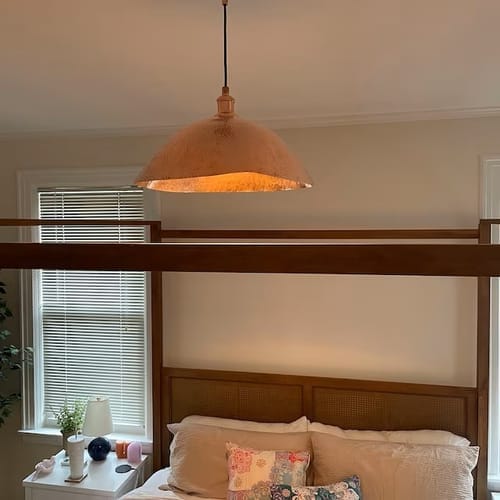
Si vous achetez des suspensions en cuivre pour les associer à d'autres luminaires en cuivre déjà présents dans la pièce, la vérification des images de produits prises dans des conditions de lumière naturelle donnera une lecture des couleurs plus précise que les photos de studio.

La Suspension Dôme Laiton Antique Patiné dans un cadre de cuisine. La surface martelée crée une chaleur texturale que les finitions lisses ne possèdent pas.
Laiton vieilli, antique et non laqué : ce que chaque finition signifie réellement
Les trois termes sont utilisés presque de manière interchangeable dans le commerce de l'éclairage, mais ils décrivent des choses véritablement différentes. Il est important de bien comprendre cela, car les finitions se comportent différemment au fil du temps.
Le laiton vieilli est une finition appliquée en usine. Le fabricant traite la surface en laiton pour produire un aspect plus sombre et pré-usé avant que le luminaire ne quitte l'atelier. Le résultat est une finition fixe ou quasi fixe : il a l'air vieilli à l'arrivée et le restera globalement. Certaines finitions en laiton vieilli sont laquées pour préserver l'apparence.
Le laiton antique est un terme marketing qui chevauche considérablement le laiton vieilli. Dans la plupart des contextes de vente d'éclairage en France, il fait référence à une teinte de laiton plus foncée et pré-patinée, parfois avec des reflets délibérés dans les zones en relief pour suggérer l'âge. Comme le laiton vieilli, il s'agit généralement d'une finition stable plutôt que d'une finition vivante. Le laiton non laqué, parfois appelé laiton brut ou vivant, est du laiton dans son état naturel sans patine d'usine appliquée et sans revêtement de laque. La surface s'oxydera en réponse à la lumière, à l'air et à l'humidité. Étant donné qu'une suspension ne subit presque aucune manipulation, le changement est lent et est entraîné par l'environnement plutôt que par le contact. Si vous voulez une finition qui devient plus intéressante avec le temps, le laiton non laqué est le bon choix. Si vous voulez une apparence vieillie constante dès le premier jour sans changement visible supplémentaire, le laiton vieilli ou antique vous conviendra mieux. L'article sur les suspensions en laiton vieilli vs laiton antique couvre la différence complète en détail.Guide des dimensions et de la hauteur de suspension pour les îlots de cuisine
Ce sont les deux questions qui apparaissent dans presque toutes les recherches de suspensions, et les réponses sont plus spécifiques que la plupart des guides ne le proposent.
Hauteur de suspension
Mesurez de la base de la suspension à la surface du plan de travail. La plage de travail est de 70 à 90 cm. À 70 cm, la lumière est concentrée et la suspension semble proche et intime. À 90 cm, il y a plus d'espace visuel et la suspension s'intègre à l'ensemble de la cuisine. Pour des hauteurs de plafond standard de 2,4 à 2,7 mètres, 75 à 80 cm du plan de travail à la base de la suspension est un bon point de départ. Pour des plafonds de plus de 3 mètres, 85 à 90 cm du plan de travail semble plus proportionné.
Diamètre de la suspension par rapport à la longueur de l'îlot
Une erreur fréquente dans le dimensionnement des suspensions est de choisir uniquement en fonction de la hauteur du plafond. La hauteur du plafond détermine la longueur du cordon, pas le diamètre de la suspension. C'est la longueur de l'îlot qui détermine la taille de la suspension.
Options de suspension et longueurs de cordon
Le type de suspension modifie la perception d'une suspension dans une pièce presque autant que l'abat-jour lui-même. Insideast propose quatre options de suspension pour ses suspensions dôme en laiton et en cuivre, et la longueur du cordon peut être spécifiée au moment de la commande afin que la hauteur de suspension soit correcte avant l'arrivée du luminaire, plutôt que de nécessiter un ajustement après l'installation.

Les quatre options de suspension disponibles dans la gamme de suspensions Insideast.
Quatre façons de suspendre
Chaque type de suspension crée un registre visuel différent. Les options de cordon donnent à la suspension un aspect léger et architectural. Les options de chaîne et de tige confèrent au luminaire plus de solidité et de poids visuel entre le plafond et l'abat-jour. Toutes les longueurs peuvent être personnalisées lors de la commande. Si vous avez une hauteur de plafond spécifique ou une hauteur de suspension précise en tête, incluez-le dans vos notes de commande et il sera coupé à la longueur avant l'expédition.
Pendentif unique ou grappe : règles d'espacement
Une grappe de deux ou trois pendentifs au-dessus d'un îlot de cuisine est devenue l'une des approches les plus courantes dans la conception des cuisines au Royaume-Uni. Le rendu fonctionne bien mais exige plus de précision qu'un pendentif unique pour éviter de donner une impression d'encombrement ou de déséquilibre.
La règle fondamentale pour les grappes de pendentifs est un espacement égal entre les pendentifs et un dégagement égal à chaque extrémité de l'îlot. Si deux pendentifs sont espacés de 60 cm, les bords extérieurs de ces pendentifs doivent se trouver à au moins 30 à 40 cm des extrémités de l'îlot. Les pendentifs placés trop près des extrémités de l'îlot donnent l'impression qu'ils n'avaient plus de place plutôt que d'être délibérément positionnés.
Pour les grappes de deux, le centrage de la paire sur le milieu de l'îlot avec 60 à 70 cm entre eux fonctionne de manière fiable sur la plupart des proportions d'îlots. Un espacement de plus de 80 cm entre deux pendentifs commence à faire paraître la paire comme deux luminaires distincts plutôt qu'un regroupement réfléchi.
Le pack de 2 avec rosace rectangulaire
Pour les acheteurs qui souhaitent deux pendentifs au-dessus d'un îlot sans les incertitudes des installations séparées, le set de deux pendentifs en cuivre oxydé comprend une seule rosace rectangulaire allongée en cuivre oxydé qui se monte au plafond et maintient les deux pendentifs à un espacement prédéfini. Les deux chutes de pendentifs sont déjà équilibrées depuis le même point de plafond, ce qui signifie que la décision d'espacement est prise au niveau du produit plutôt qu'au niveau de l'installation. La rosace rectangulaire est affleurante au plafond comme un seul raccord, et les deux dômes pendent en dessous sur des cordons en tissu noir de longueurs assorties. Pour les îlots de 150 à 200 cm, c'est le moyen le plus simple d'obtenir une grappe réfléchie et symétrique.

Le set de deux pendentifs en cuivre avec rosace rectangulaire. Une connexion au plafond, deux pendentifs, pré-espacés.
La finition d'un pendentif vieillit-elle comme un robinet ?
Non, et la raison est importante pour fixer des attentes réalistes. La patine du laiton non laqué se développe à travers deux processus principaux : l'oxydation due à l'exposition à l'air et à la lumière, et les huiles transférées par les mains humaines lors d'un contact régulier. Un robinet de cuisine est manipulé des dizaines de fois par jour. Un luminaire suspendu n'est touché que lors du changement d'ampoule, peut-être une ou deux fois par an.
Le résultat est une courbe de vieillissement complètement différente. Un robinet en laiton utilisé quotidiennement montrera ses premiers tons ambrés chauds en quelques semaines. Un pendentif en laiton dans la même cuisine, suspendu au-dessus de l'îlot et essentiellement intouché, développera sa patine très lentement. Après trois à cinq ans, un pendentif en laiton aura l'air subtilement plus chaud et plus riche qu'à son installation, mais le changement sera progressif et doux plutôt que spectaculaire.
Les pendentifs en cuivre se développent plus activement que le laiton car le cuivre est un métal plus réactif, même en l'absence de manipulation. La vapeur de cuisson, les changements d'humidité et l'air ambiant contribuent tous à une surface qui s'approfondit lentement au fil du temps. Si votre pendentif a déjà une finition pré-oxydée, comme le pendentif dôme en cuivre oxydé, le point de départ est déjà un stade de patine avancé. Un changement ultérieur dans cette direction se traduira par un approfondissement, un assombrissement et une stabilisation au fil des ans.
« J'adore, mais une chose aurait pu être améliorée. La rosace de plafond est en cuivre brillant et le dôme est vieilli avec un aspect plus noir et plus vintage. La rosace aurait été plus belle si elle avait été assortie, mais j'en suis ravie. Et je l'achèterais à nouveau. »
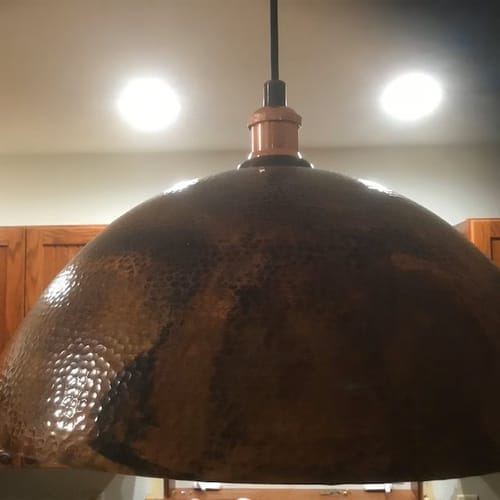
L'observation de Jane concernant la différence de finition entre la rosace et le dôme mérite d'être abordée directement. Sur le pendentif dôme en cuivre oxydé, le dôme reçoit le traitement d'oxydation foncée complet, tandis que la rosace de plafond a une surface de cuivre plus brillante. Les deux composants sont intentionnellement à différents stades de traitement. Au fil du temps, les deux continueront à évoluer dans la même direction, bien que la rosace, étant plus haute et moins exposée à l'humidité de cuisson, changera plus lentement. Dans la plupart des installations, la rosace est soit plate contre le plafond, soit à peine visible à hauteur des yeux. Jane a tout de même acheté à nouveau, ce qui reflète le résultat habituel : le caractère de la finition et la qualité du matériau importent plus qu'une consistance exacte entre un dôme et un raccord de plafond.
Foire aux questions
Questions fréquentes sur les suspensions en laiton et en cuivre
Quelle taille de suspension pour un îlot de cuisine ?
Pour une seule suspension au-dessus d'un îlot de cuisine, un diamètre de dôme de 30 à 40 cm convient bien à la plupart des îlots standard jusqu'à 150 cm de long. Pour les îlots plus longs, deux ou trois suspensions de 25 à 35 cm de diamètre espacées uniformément ont un aspect plus étudié qu'un seul grand luminaire. Une règle utile : la largeur combinée de vos suspensions ne doit pas dépasser les deux tiers de la longueur de l'îlot. En cas de doute, optez pour une taille légèrement plus petite plutôt que plus grande. Les suspensions ont tendance à paraître plus grandes en personne que sur les photos de produits.
À quelle hauteur les suspensions doivent-elles être placées au-dessus d'un îlot de cuisine ?
La règle standard est de 70 à 90 cm entre la base de la suspension et la surface du plan de travail de l'îlot. À 70 cm, la lumière se concentre étroitement sur la surface et la suspension semble proche et intime. À 90 cm, il y a plus d'espace visuel et la suspension s'inscrit dans l'ensemble de la pièce. Pour les plafonds supérieurs à 3 mètres, une hauteur de 85 à 90 cm par rapport au plan de travail a tendance à être plus proportionnée. Les suspensions Insideast sont disponibles avec des longueurs de cordon personnalisées, de sorte que la hauteur de suspension peut être spécifiée avant l'arrivée du luminaire.
Les suspensions en laiton sont-elles toujours à la mode ?
Les suspensions en laiton non laqué et vieilli sont une présence constante dans la conception des cuisines britanniques depuis environ 2018 et ne montrent aucun signe de déclin. La raison est en partie matérielle : une finition vivante qui développe une patine au fil des ans est réellement différente d'une finition polie ou laquée qui reste statique. Les designers travaillant avec des matériaux naturels, des plans de travail en pierre et des carreaux faits à la main reviennent sans cesse au laiton non laqué car il appartient à la même famille de matériaux. Le laiton poli a eu son heure de gloire dans les années 1980 et est passé. Le laiton non laqué est une finition différente et une autre conversation.
Quelle est la différence entre les suspensions en laiton et en cuivre ?
Le laiton est un alliage de cuivre et de zinc. Le cuivre est un métal pur. Tous deux ont des tons chauds et vieillissent avec le temps, mais ils commencent et finissent différemment. Le laiton non laqué commence par un ton jaune-doré et vieillit vers des tons ambrés chauds et miel. Le cuivre massif commence par un ton or rose plus vif et vieillit vers un rouge-brun plus profond. Le cuivre est généralement plus réactif que le laiton, il a donc tendance à développer sa patine plus rapidement dans le même environnement.
Les suspensions en laiton patinent-elles de la même manière que les robinets en laiton ?
Non. Les suspensions en laiton vieillissent plus lentement que les robinets en laiton car elles ne sont presque pas manipulées directement. Un robinet est touché des dizaines de fois par jour, et le contact accélère considérablement la patine. Une suspension n'est touchée que lors du changement d'ampoule. Le résultat est un changement plus lent et plus progressif, entraîné par l'air et l'humidité ambiante plutôt que par le contact. Attendez-vous à un subtil approfondissement du ton au fil des ans plutôt qu'au changement plus rapide et plus visible que vous voyez sur un robinet de cuisine.
Toutes les suspensions en laiton et en cuivre de ce guide sont fabriquées à la main dans l'atelier Insideast à Marrakech. Parcourez la collection complète de suspensions et la gamme complète de luminaires, ou lisez le guide complémentaire sur les suspensions en laiton vieilli vs laiton antique pour en savoir plus sur la terminologie des finitions et ce à quoi vous attendre au fil du temps.


