

Fait main dans l'atelier Insideast à Marrakech. Découvrez la collection complète de suspensions.
« Le laiton vieilli est si intemporel, et j'adore son aspect patiné. Les nouvelles pièces en laiton peuvent parfois paraître trop brillantes, surtout si votre maison est remplie de pièces plus anciennes et de trouvailles patinées », a déclaré Drew Scott, architecte d'intérieur et créateur chez Lone Fox Home. Entrez dans n'importe quel showroom d'éclairage au Royaume-Uni et vous comprendrez exactement ce qu'il veut dire. Les suspensions étiquetées laiton vieilli, laiton antique, laiton vintage et laiton non verni appartiennent toutes à la même famille de couleurs chaudes, sans presque aucune explication sur ce que ces termes signifient réellement ou comment les finitions se comportent différemment au fil du temps.
La confusion est compréhensible. Ces finitions se ressemblent sur une étagère ou sur une photographie. Mais elles sont fabriquées différemment, et cette différence détermine l'aspect de la suspension dans cinq ans, et pas seulement le jour de l'installation. Ce guide explique ce que chaque terme signifie réellement, comment chaque finition est fabriquée, à quoi s'attendre de chacune au fil du temps, et une section que la plupart des guides de suspensions ignorent entièrement : la texture de surface du métal lui-même, qui affecte l'aspect d'une suspension dans une pièce autant que la couleur de sa finition.
- Le laiton vieilli et le laiton antique sont généralement des finitions appliquées en usine. La suspension arrive déjà patinée et le reste globalement.
- Le laiton non verni est un métal brut, non revêtu. Il développe sa propre patine progressivement dans votre maison, sous l'effet de l'air, de l'humidité et de la lumière.
- Insideast peut accélérer le processus de vieillissement sur le laiton non verni en utilisant des méthodes de finition traditionnelles, si demandé. Le métal reste non verni.
- La texture de surface (brossée, martelée lisse, martelée à la main) est un choix distinct de la couleur de la finition et affecte l'aspect de la suspension dans une pièce plus que la plupart des acheteurs ne s'y attendent.
- Les suspensions vieillissent plus lentement que les robinets car elles sont très peu manipulées directement.
- Le laiton vieilli et les finitions en cuivre chaud se mélangent naturellement dans la même pièce. Les métaux froids (chrome, nickel) créent un contraste plutôt qu'une harmonie.
Ce que signifient réellement laiton vieilli, antique et non verni
Ces trois termes sont utilisés de manière presque interchangeable dans le commerce de l'éclairage au Royaume-Uni, mais ils décrivent des choses significativement différentes. Il est important de bien comprendre cela avant d'acheter, car les finitions se comportent différemment au fil du temps.

Laiton naturel non verni (gauche) vs laiton vieilli (droite). Même forme de dôme, deux relations différentes avec le temps.
La distinction fondamentale
Finition fixe vs finition vivante
Le laiton vieilli a été délibérément traité par le fabricant pour produire une apparence pré-usée, plus foncée avant que le luminaire ne quitte l'atelier. Il arrive déjà patiné et est conçu pour le rester globalement.
Le laiton antique se chevauche significativement en pratique. La plupart des fabricants l'utilisent pour un ton pré-traité plus foncé, plus uniforme, souvent avec une teinte brunâtre plutôt que dorée. Ni le laiton vieilli ni le laiton antique ne sont des finitions vivantes qui continuent de changer notablement après l'achat.
Le laiton non verni est un métal brut sans traitement en usine, sans vernis. Il s'oxyde progressivement chez vous. Comme une suspension n'est presque jamais touchée, le changement est lent et est entraîné par l'air ambiant et l'humidité de la cuisson plutôt que par le contact.
Un quatrième terme à connaître est le laiton huilé ou le bronze huilé : un traitement brun-noir foncé qui donne au laiton une apparence très vieillie. C'est une catégorie de finition à part entière, se rapprochant le plus de la gamme de cuivre oxydé en termes de couleur de départ.
« Nous adorons notre suspension. Elle rend l'espace à la fois lumineux et chaleureux. C'est exactement ce que nous recherchions et espérions. »

Patine appliquée en usine vs vieillissement naturel : comment chaque finition est fabriquée
Comprendre le processus de production explique pourquoi le comportement à long terme de ces finitions est si différent.
Une patine appliquée en usine est créée en traitant la surface du laiton avec des produits chimiques, de la chaleur, ou les deux, avant que le luminaire ne quitte l'atelier. Les solutions acides et les composés oxydants accélèrent le processus d'oxydation naturel, compressant des années d'exposition en une étape de production contrôlée. Une fois traitée, la surface est généralement scellée avec une laque ou un revêtement protecteur pour fixer l'apparence. C'est ce qui fait du laiton vieilli et du laiton antique une finition fixe ou quasi fixe : il arrive avec un aspect vieilli et est conçu pour le rester.
De l'atelier
Ce que la surface vous dit
Le laiton non verni ne reçoit aucun traitement chimique. Il quitte l'atelier dans son état naturel, avec seulement le polissage ou la finition manuelle appliquée lors de la fabrication. Pas de patine, pas de vernis scellant la surface. Le métal est exposé à l'environnement dès le moment de son installation.
Dans une suspension, qui n'est presque jamais touchée, le laiton non verni change lentement : un subtil approfondissement de la tonalité au fil des mois et des années, entraîné par l'air ambiant et l'humidité de la cuisson. C'est une courbe de vieillissement très différente de celle d'un robinet en laiton non verni, qui est touché des dizaines de fois par jour et montre une patine visible en quelques semaines.

Détail de surface des suspensions en laiton naturel et vieilli, de l'atelier Insideast à Marrakech.
Remarque : Vieillissement accéléré chez Insideast
Si vous souhaitez une suspension en laiton qui démarre avec une apparence plus développée et vieillie mais qui reste non vernie, Insideast peut accélérer la patine naturelle en utilisant des méthodes de finition traditionnelles avant l'expédition. Le métal reste brut et continue de vieillir naturellement une fois installé. Cela est disponible sur demande via la page de personnalisation.
Expert en design
« Une tendance vers les laitons vieillis et le bronze patiné est évidente, peut-être due à un désir croissant d'ajouter une touche de glamour théâtral et vintage à la maison. Intemporels en apparence, ces détails riches et rustiques confèrent de la dimension à n'importe quelle cuisine. »
Scarlett Hampton, co-fondatrice de lights&lamps, citée dans Homes & Gardens, janvier 2025
Quelle finition semble plus authentique au fil du temps
Une suspension en laiton non verni qui a passé cinq ans dans votre cuisine aura l'air plus authentiquement vieillie qu'une suspension en laiton vieilli prétraitée achetée le même jour. La raison est simple : une finition a été acquise, l'autre a été appliquée. Sur une suspension en laiton martelé non verni, les pics de la surface captent plus d'air et de lumière que les creux, de sorte que le vieillissement est naturellement inégal : légèrement plus profond dans les creux, légèrement plus lumineux sur les pics. Un traitement uniforme en usine ne peut pas reproduire cette variation graduée avec précision.
Cela dit, la différence est moins visible sur une suspension que sur un robinet ou une poignée de porte, car les suspensions sont très rarement touchées. Au bout de cinq ans, une suspension prétraitée et une suspension non vernie vieillissant naturellement peuvent paraître assez similaires de loin. La distinction devient plus apparente de près, où le laiton non verni présente une variation qui semble réellement acquise plutôt qu'artificielle.
Il existe également un argument pratique en faveur du laiton vieilli, notamment pour les suspensions. Si vous souhaitez une apparence vieillie constante dès le premier jour, avec un minimum de changements ultérieurs, une finition en laiton vieilli bien laqué vous conviendra mieux que le laiton non verni. Aucun de ces résultats n'est mauvais. Ce sont des façons différentes d'appréhender le matériau.
« J'adore mais une chose aurait pu être améliorée. Le pavillon de plafond est en cuivre brillant et le dôme est vieilli avec un peu de noir et un aspect plus vintage. Le pavillon aurait été plus beau s'il correspondait, mais j'en suis satisfaite. Et je rachèterais. »
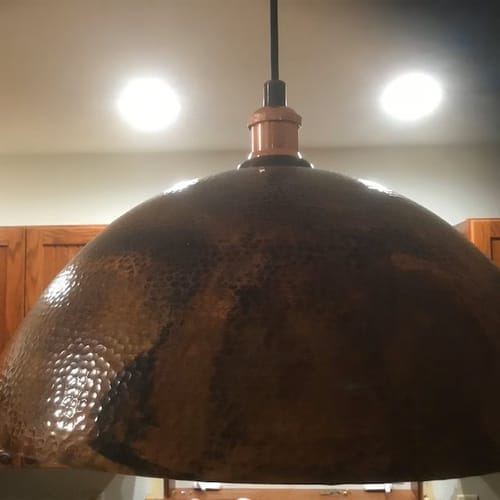
L'observation de Jane illustre directement la question de la phase de finition. Sur la suspension dôme en cuivre oxydé, le dôme reçoit le traitement d'oxydation foncé complet en atelier, tandis que le pavillon de plafond commence avec une surface de cuivre plus brillante. Les deux s'assombriront au fil du temps dans la même direction, bien que le pavillon, reposant à plat contre le plafond et recevant moins d'humidité de cuisson, changera plus lentement. Dans la plupart des installations, le pavillon est à peine visible à hauteur des yeux. Jane a racheté.
Texture de surface : brossé, martelé lisse, martelé à la main
La plupart des guides de suspensions abordent la couleur de la finition et s'arrêtent là. La texture de surface est rarement traitée, même si elle affecte l'aspect d'une suspension dans une pièce autant que la couleur, en particulier pour les suspensions en laiton et en cuivre où la texture du métal détermine la façon dont la lumière s'y diffuse.
Chez Insideast, la même forme de dôme est disponible en trois traitements de surface distincts, qui sont indépendants de la couleur de la finition. Vous pouvez avoir une finition vieillie ou oxydée avec n'importe laquelle de ces textures. La texture est une décision indépendante de la patine.
Le processus de martelage dans l'atelier Insideast à Marrakech. Chacun des trois traitements de surface ci-dessous est appliqué à la main sur du laiton ou du cuivre massif.
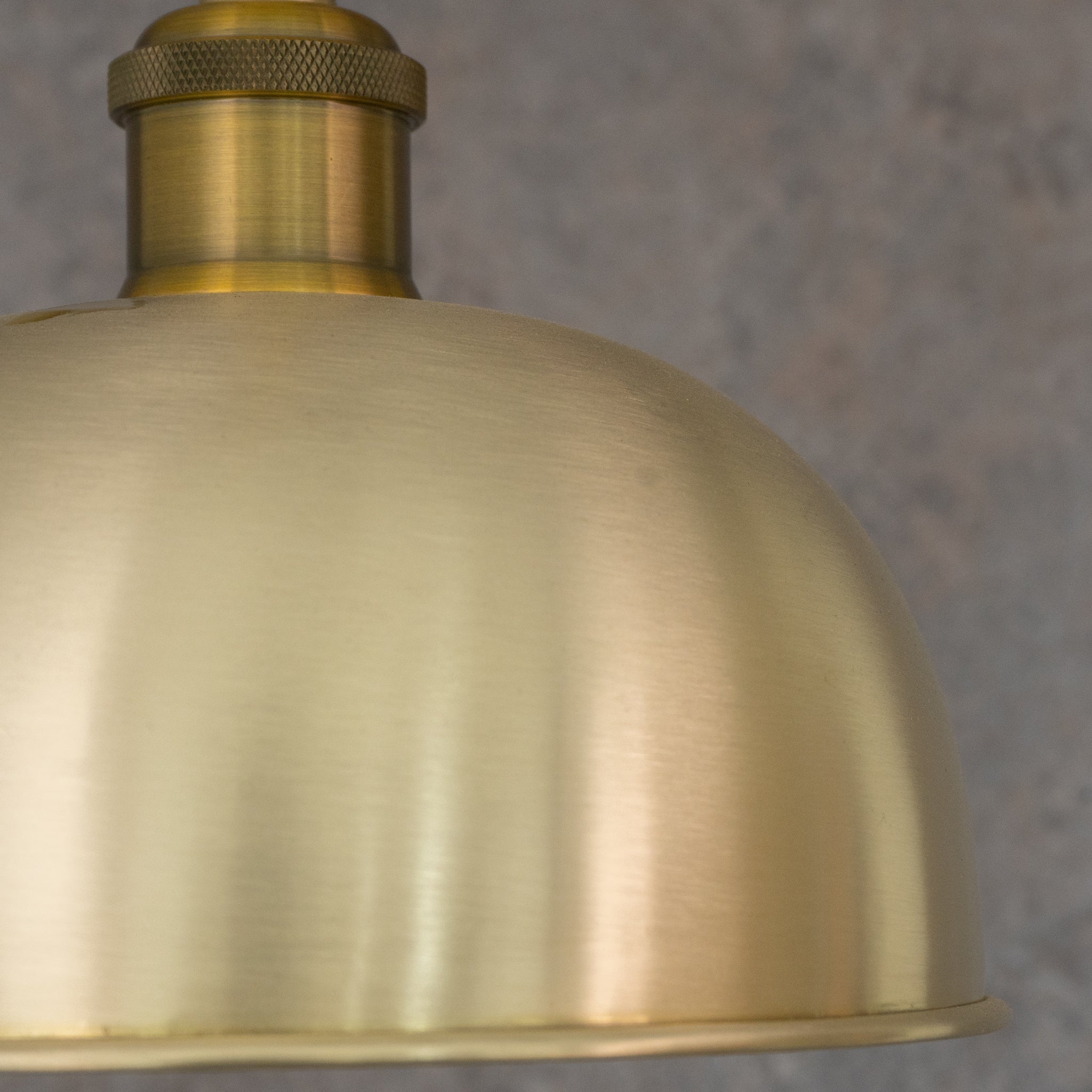
Surface 01
Brossé
Finition lisse et directionnelle appliquée à la main. Pas de marques de martelage. Reflète la lumière uniformément dans une direction. La texture la plus discrète de la gamme.
Voir la suspension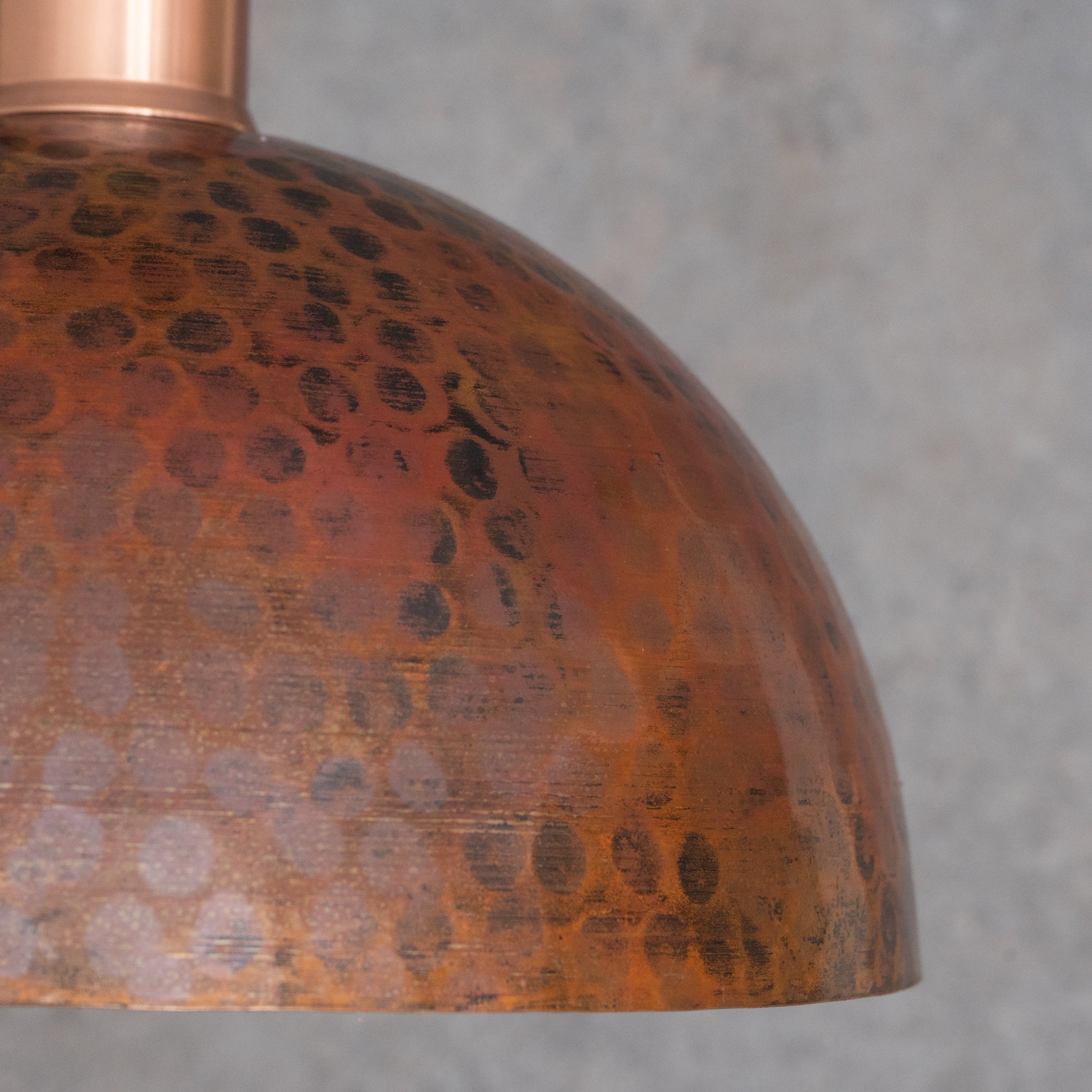
Surface 02
Martelé lisse
Indentations régulières et douces sur toute la surface. Visibles mais contrôlées. Crée un jeu de lumière facetté sans texture prononcée.
Voir la suspension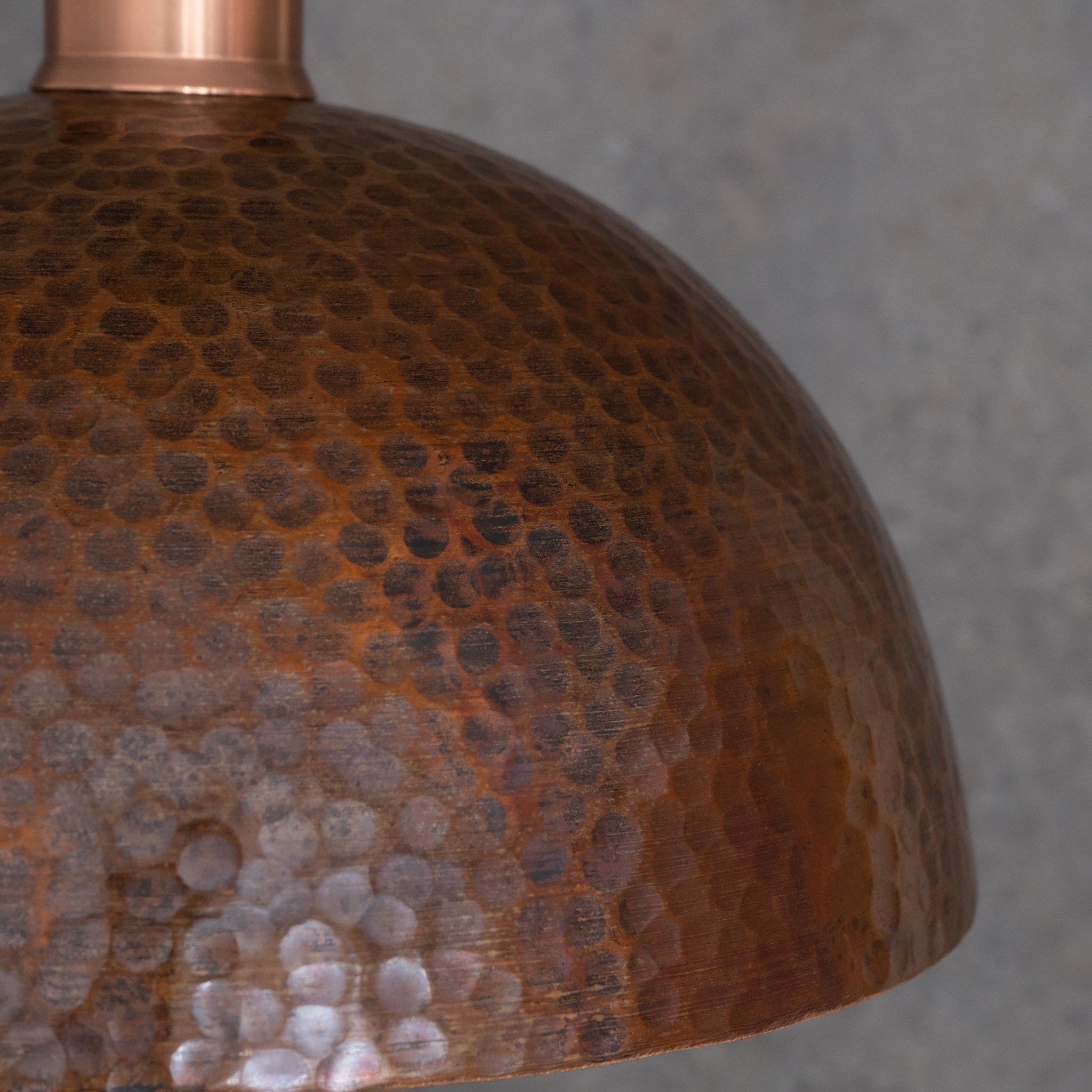
Surface 03
Martelé à la main
Marques prononcées et irrégulières des coups de marteau individuels. Deux surfaces ne sont jamais identiques. Crée le mouvement de lumière le plus fort et donne une impression clairement artisanale.
Voir la suspensionLa conséquence pratique de la texture est la plus visible lorsque la suspension est allumée. Une suspension brossée reflète la lumière dans une seule direction lisse. Une suspension martelée lisse la disperse sur des dizaines de petites facettes, créant un scintillement subtil sous une lumière chaude. Une suspension martelée à la main crée le plus de mouvement : la surface irrégulière capte et reflète la lumière différemment sous chaque angle, de sorte que la suspension semble vivante même lorsque la pièce est immobile. Pour les cuisines utilisant des LED blanc chaud à 2 700 K, les suspensions martelées à la main sont particulièrement bien mises en valeur car la chaleur de la lumière joue avec la surface irrégulière d'une manière que les finitions plus lisses ne peuvent pas reproduire.
Options de suspensions Insideast et à quoi s'attendre
La gamme de suspensions Insideast couvre les principales catégories de finitions abordées dans ce guide. Chacune est fabriquée à partir de métal massif dans l'atelier de Marrakech. Les quatre options ci-dessous représentent les principales orientations de finition disponibles : laiton naturel non laqué, laiton brossé, cuivre oxydé vieilli et bronze antique.
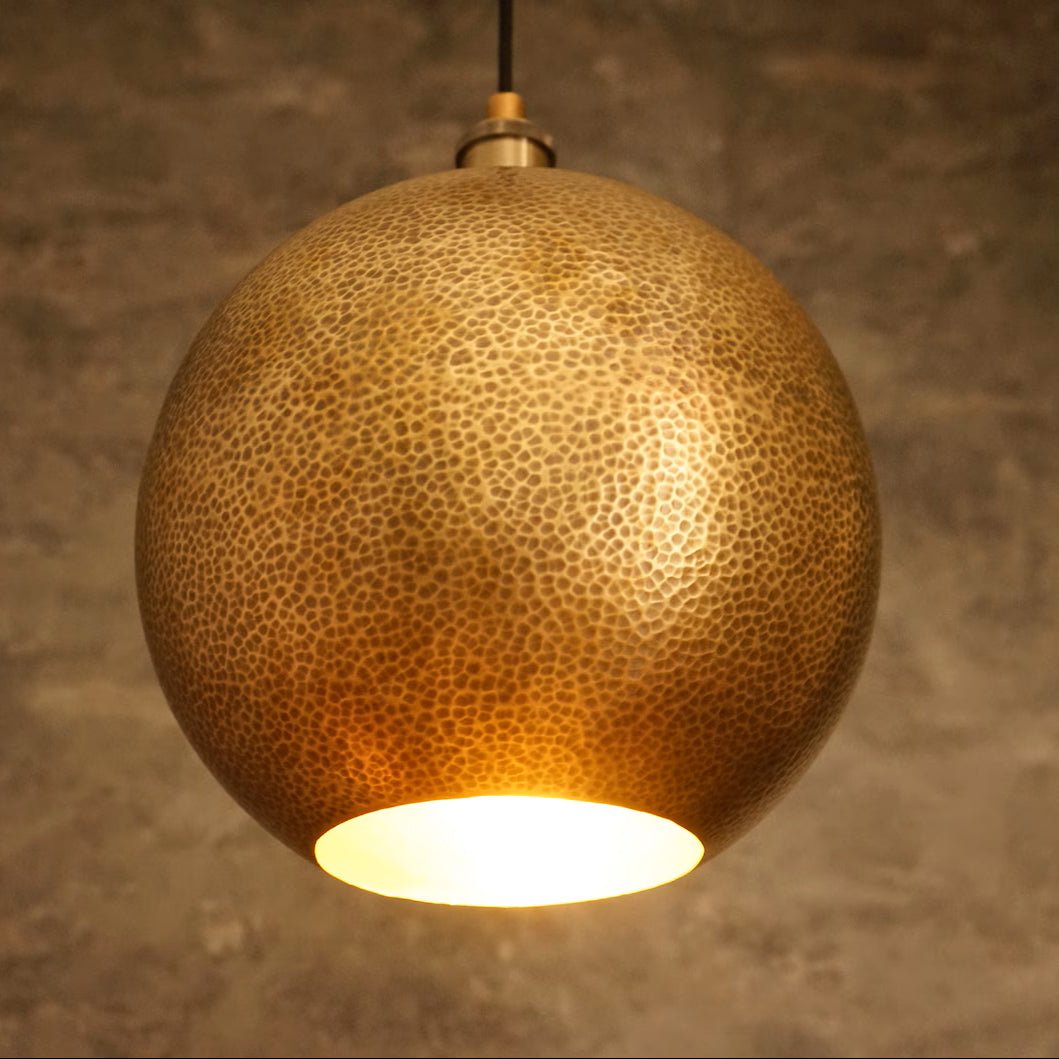
Laiton naturel / non laqué
Suspension boule en laiton martelé
Dôme doré jaune chaud en laiton naturel non laqué. S'approfondira progressivement vers l'ambre avec le temps. La surface martelée à la main crée du mouvement lorsqu'elle est allumée.
Voir la suspension
Laiton brossé
Suspension cône en laiton brossé
Surface brossée à la main avec un éclat directionnel doux. Le plus sobre des suspensions en laiton. Convient aux cuisines minimalistes et de transition.
Voir la suspension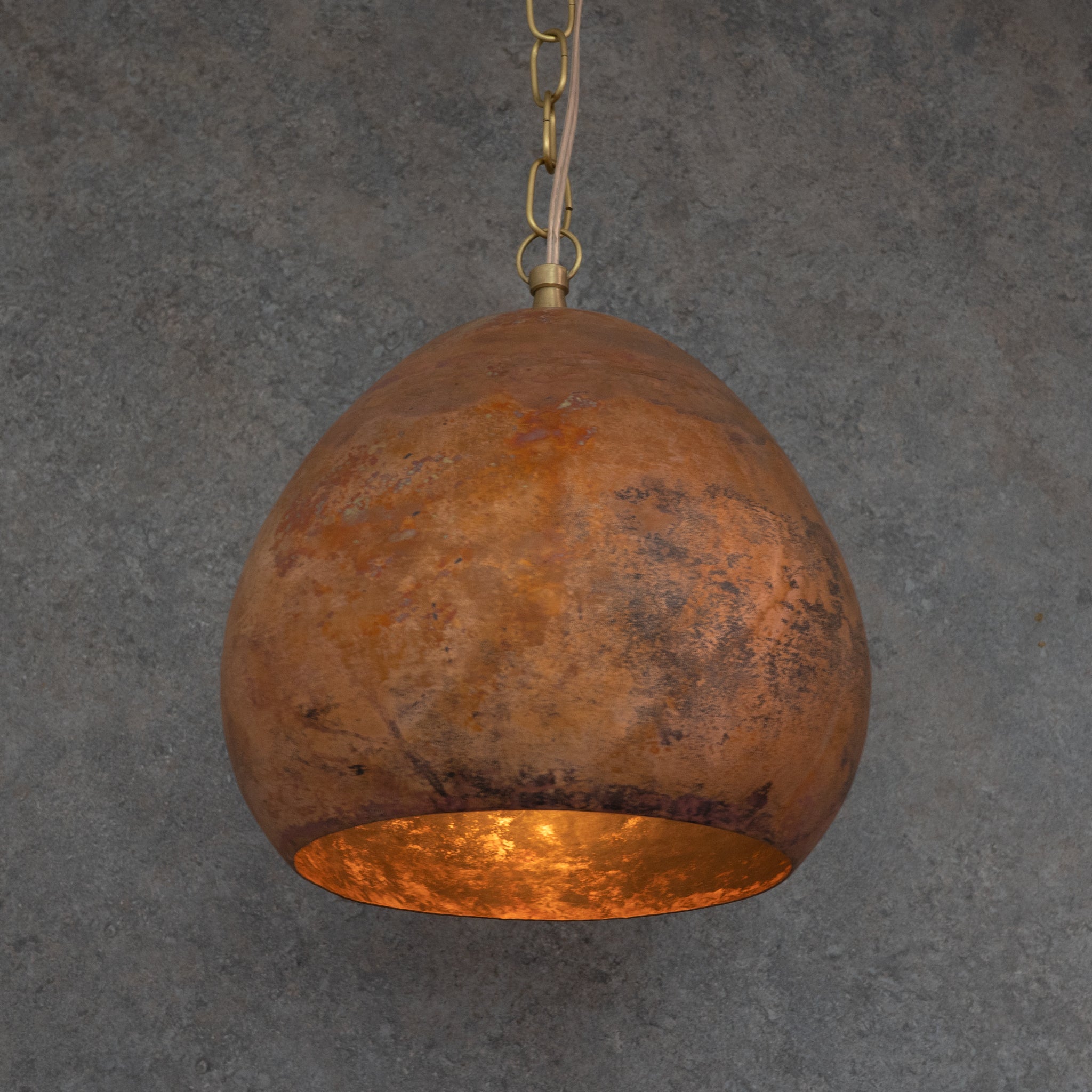
Cuivre oxydé / vieilli
Suspension goutte en cuivre oxydé
Pré-oxydé en atelier pour un ton cuivre foncé riche. Arrive avec une finition vieillie développée. Continuera à s'approfondir lentement avec le temps dans votre maison.
Voir la suspension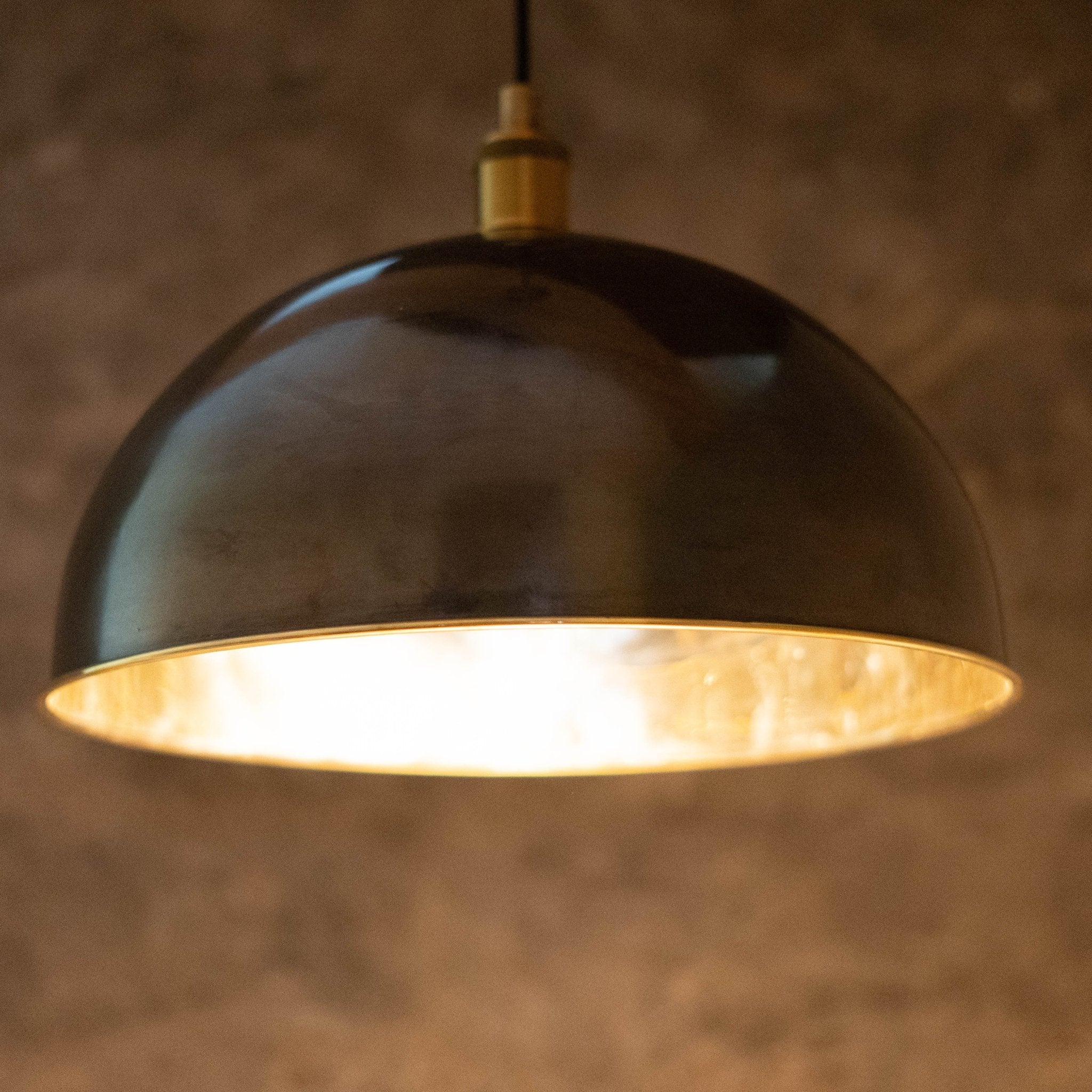
Bronze antique
Suspension dôme en bronze antique
Un traitement de couleur bronze foncé appliqué en atelier. La finition la plus stable de la gamme : arrive vieillie et conserve cette apparence avec le temps.
Voir la suspension
Suspension cylindrique en laiton martelé en laiton naturel non laqué. Trois suspensions regroupées au-dessus d'un îlot de cuisine.
En contexte
Comment le laiton non laqué se présente dans une vraie cuisine
La suspension cylindrique en laiton naturel non laqué montre le point de départ jaune-doré chaud avant l'apparition de toute patine. Regroupée par trois au-dessus d'un îlot de cuisine, la surface martelée à la main capte la lumière sous plusieurs angles, créant un mouvement sur le métal qu'une finition pré-vieillie ou laquée ne produit pas.
Avec le temps, la surface s'approfondira vers un ton ambré plus riche. Étant donné que ces suspensions ne sont touchées que lors du changement d'ampoule, ce vieillissement sera lent et progressif, entraîné par la lumière ambiante et l'humidité de la cuisson plutôt que par le contact.
| Finition | Apparence initiale | Évolue avec le temps ? | Idéal pour |
|---|---|---|---|
| Laiton non laqué (naturel) | Doré-jaune chaud | Oui. S'approfondit progressivement vers l'ambre. Lent sur une suspension. | Les acheteurs qui veulent une finition véritablement vivante |
| Laiton brossé | Doré doux et discret avec un éclat directionnel | Très lentement si non laqué. Plus stable si scellé. | Cuisines minimalistes ou de transition |
| Cuivre oxydé / vieilli | Brun-noir profond avec des nuances de cuivre | Continue à s'approfondir lentement. Déjà à un stade avancé. | Cuisines plus sombres, esthétiques industrielles ou vintage |
| Bronze antique | Ton bronze brunâtre foncé | Minimal. La finition la plus stable de la gamme. | Les acheteurs qui veulent un look vieilli cohérent dès le premier jour |
Mélanger le laiton vieilli avec d'autres finitions dans une pièce
L'une des questions les plus fréquentes après l'achat d'une suspension est de savoir si la finition s'accordera bien avec les autres métaux de l'espace. Dans les cuisines britanniques, il est courant d'avoir des robinets en laiton non laqué, des luminaires en laiton vieilli ou antique, et des accessoires en cuivre ou en bronze dans la même pièce. Que cela paraisse cohérent ou confus dépend presque entièrement du sous-ton.
Le laiton vieilli, le laiton antique et le laiton naturel non laqué appartiennent tous à la famille des métaux chauds et dorés. Ils partagent un sous-ton même si leurs couleurs de surface diffèrent. Une suspension en laiton vieilli plus foncé au-dessus d'un îlot de cuisine s'harmonisera confortablement avec des robinets en laiton non laqué, car les deux vont dans la même direction : jaune-doré chaud à la base, s'approfondissant vers l'ambre et le brun avec le temps. Le contraste entre une surface non laquée plus récente et une suspension pré-vieillie est perçu comme une variation intentionnelle au sein d'une famille, et non comme un choc.
Le mélange devient plus difficile lorsque des finitions en laiton chaud sont associées à des métaux aux tons froids : nickel brossé, chrome ou acier inoxydable poli. Les métaux froids reflètent une lumière bleu-gris. Le laiton chaud reflète une lumière jaune-ambre. Sous la même LED blanc chaud, les deux semblent appartenir à des familles de couleurs différentes. C'est pourquoi la plupart des designers conseillent de choisir soit des métaux chauds, soit des métaux froids comme finition dominante dans une cuisine, plutôt que de mélanger les deux librement. Pour plus d'informations sur la cohésion entre les luminaires en laiton, consultez le guide sur le laiton non laqué et son vieillissement.
Le laiton vieilli et le cuivre se mélangent naturellement. Le cuivre est lui-même un métal de ton chaud, et en vieillissant, il passe du rose-doré aux tons rouge-brun, le tout s'harmonisant avec le laiton vieilli dans la gamme ambre-brun. Si votre cuisine a des suspensions en cuivre et que vous ajoutez des robinets en laiton, ou vice versa, les deux ne s'entrechoqueront pas. Les chronologies de patine diffèrent, mais la direction des couleurs est compatible.
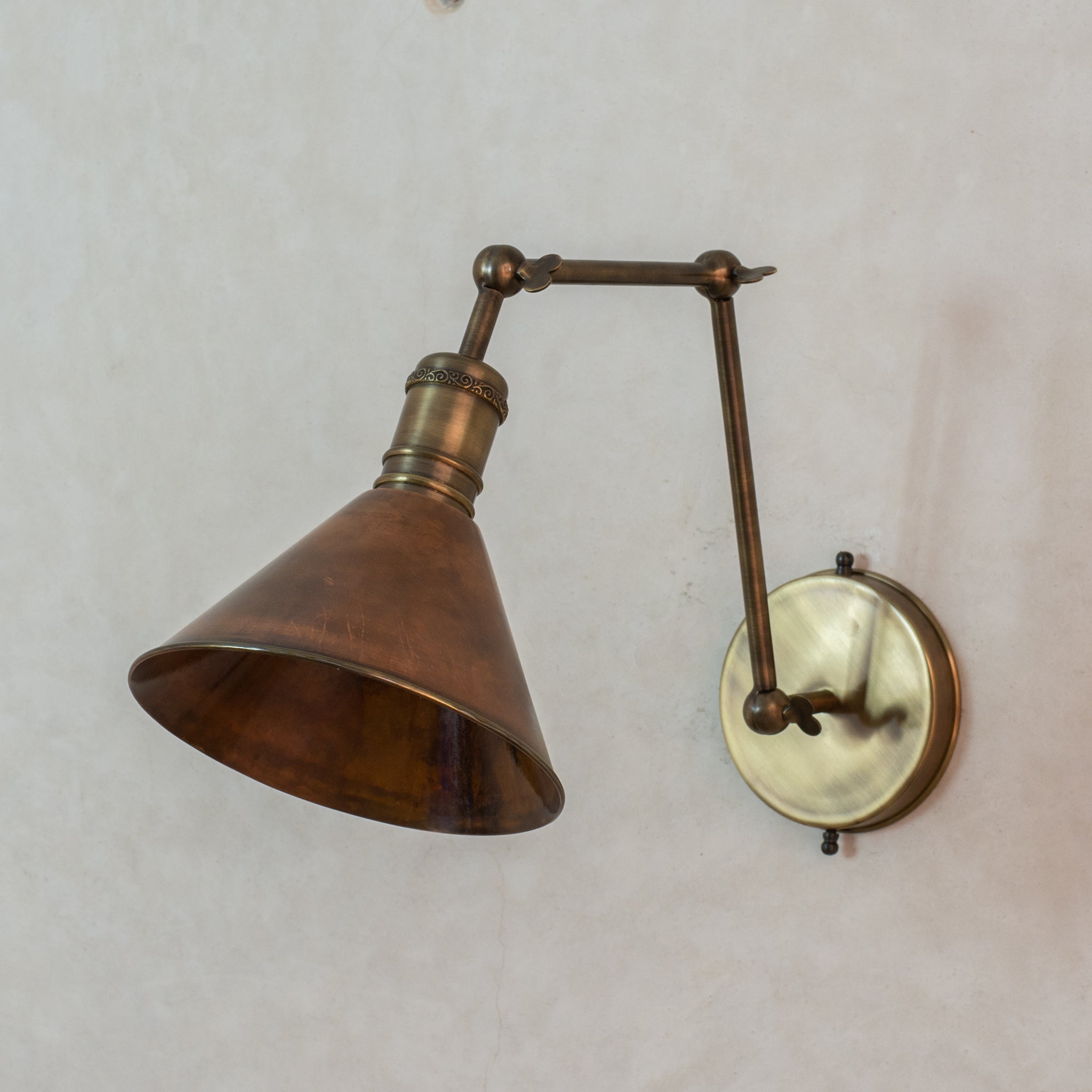
Étendre le cuivre vieilli à l'éclairage mural
L'applique murale en cuivre oxydé présente la même finition en cuivre vieilli que les suspensions dôme, montée sur un bras pivotant réglable en trois points. Une pièce d'accompagnement directe pour un cuivre vieilli cohérent entre la suspension et l'éclairage mural dans la même pièce. "La lampe murale est magnifique. Le vendeur est très rapide à répondre aux messages." (Debbie, Etsy, janvier 2026)
Voir l'applique muralePour un guide plus large sur les suspensions en laiton et en cuivre, y compris les tailles, la hauteur de chute, les options de suspension et les différences entre les matériaux dans un environnement de cuisine, consultez l'article complémentaire : Suspensions en laiton et en cuivre pour îlots de cuisine : le guide complet.
Questions fréquemment posées
Questions courantes sur les suspensions en laiton vieilli et antique
Quelle est la différence entre le laiton vieilli et le laiton antique ?
Les deux termes désignent des finitions délibérément traitées pour produire une apparence pré-usée et plus foncée avant que le luminaire ne vous parvienne. Le laiton vieilli tend vers un brun ambré chaud avec de la profondeur dans les creux. Le laiton antique est généralement légèrement plus foncé et plus uniforme, souvent avec une teinte brunâtre plutôt que dorée. En pratique, de nombreux fabricants utilisent les termes de manière interchangeable. Ni l'un ni l'autre n'est une finition vivante qui continuera à changer de manière significative après l'achat, à moins que la surface ne soit laissée non laquée.
Les suspensions en laiton antique sont-elles toujours à la mode ?
Oui. Les suspensions en laiton vieilli et antique sont une présence constante dans le design des cuisines britanniques depuis environ 2018 et restent très demandées. Le terme de recherche "suspensions en laiton vieilli" génère environ 880 recherches mensuelles au Royaume-Uni, reflétant un intérêt soutenu des acheteurs plutôt qu'une tendance passagère. Le laiton vieilli fait partie d'une famille plus large de finitions en métal chaud, y compris le laiton non laqué, le cuivre oxydé et le bronze antique, qui continuent toutes à bien fonctionner dans la conception des cuisines et des salles à manger au Royaume-Uni.
À quoi ressemble le laiton vieilli dans une vraie cuisine ?
Le laiton vieilli dans une cuisine se présente comme un doré chaud et discret avec des creux plus foncés. Sous un éclairage LED blanc chaud à 2 700 K (la recommandation standard pour les cuisines avec des luminaires en laiton), le laiton vieilli apparaît plus riche et plus profond que sur les photos de produits, qui sont souvent prises sous une lumière de studio neutre ou froide. Dans les cuisines avec des plans de travail en pierre naturelle, des armoires en bois ou des carreaux de Zellige, le laiton vieilli s'intègre naturellement car le matériau partage le même registre de couleur chaud et organique que ces surfaces.
Une suspension en laiton vieilli se ternira-t-elle davantage une fois installée ?
Cela dépend si la finition est scellée. La plupart des finitions en laiton vieilli appliquées en usine sont laquées pour maintenir l'apparence en place, auquel cas tout changement visible est minime. Si la suspension est laissée non laquée malgré un point de départ pré-vieilli, elle continuera à évoluer, bien que lentement, car les suspensions ne sont presque jamais directement manipulées. Les suspensions non laquées vieillissent principalement sous l'effet de l'air ambiant et de l'humidité de la cuisson plutôt que par contact, de sorte que le changement est graduel et subtil sur des années plutôt que des mois.
Puis-je mélanger des suspensions en laiton vieilli avec des robinets en laiton non laqué ?
Oui. Le laiton vieilli et le laiton non laqué partagent des sous-tons chauds et dorés et s'harmonisent confortablement. La différence de couleur entre eux (le laiton vieilli est plus foncé et plus discret, le laiton non laqué est plus clair au début) se réduira avec le temps à mesure que le robinet non laqué s'approfondira avec l'usage quotidien. Étant donné que les suspensions vieillissent beaucoup plus lentement que les robinets, le robinet non laqué peut progressivement atteindre une teinte plus proche de votre suspension en laiton vieilli sur plusieurs années.
Insideast peut-il vieillir le laiton non laqué avant l'expédition ?
Oui. Insideast peut accélérer la patine naturelle sur le laiton non laqué en utilisant des méthodes de finition traditionnelles avant l'expédition. Le métal reste non laqué tout au long du processus, ce qui signifie qu'il continuera à vieillir naturellement une fois installé chez vous. Cette option est disponible sur mesure. Contactez l'équipe via la page de personnalisation pour discuter de vos besoins avant de commander.
Toutes les suspensions de ce guide sont fabriquées à la main dans l'atelier Insideast à Marrakech. Parcourez la collection complète de suspensions, ou lisez le guide complémentaire sur les suspensions en laiton et en cuivre pour îlots de cuisine pour des conseils sur la taille, la suspension et la hauteur de chute. Pour l'éclairage mural avec des finitions en cuivre vieilli et laiton assorties, consultez la collection d'appliques murales en laiton.


