


Le robinet de cuisine Heritage avec poignées en croix. Fabriqué à la main à Marrakech et expédié directement de l'usine.
La décoratrice d'intérieur Mariah Tapia avait une vision claire pour sa cuisine : laiton non verni, robinet de pont, remplisseur de pot, le tableau complet. « Avoir du laiton non verni dans notre cuisine a été un RÊVE », a-t-elle écrit à ses 126 000 abonnés. « C'est un laiton magnifique qui, à mon avis, s'améliore avec l'âge. » Ce qu'elle ne mentionne pas dans cette légende, c'est le temps qu'il lui a fallu pour trouver le bon style, la bonne hauteur de bec, le bon format de poignée pour la façon dont elle cuisine réellement.
C'est à ce niveau de décision que la plupart des acheteurs se retrouvent bloqués. Le choix de la finition est facile une fois que vous avez fait vos recherches. Les questions plus difficiles sont celles qui suivent : robinet de pont ou monotrou, bec col de cygne ou droit, avec ou sans douchette, poignées en croix ou à levier. Ce ne sont pas seulement des questions esthétiques. Chacune affecte la façon dont le robinet s'installe, comment la finition vieillit et comment il fonctionne dans une cuisine utilisée quotidiennement.
Ce guide couvre tous les styles de robinets de cuisine en laiton non verni, ce qui les rend différents, et comment choisir en fonction de votre évier, de votre cuisine et de la façon dont vous cuisinez réellement.
- Les robinets de pont nécessitent deux trous d'évier (ou une plaque de pont) ; les robinets monotrou n'en nécessitent qu'un
- Un bec col de cygne dégage les grandes casseroles ; un bec droit convient aux éviers moins profonds et aux cuisines plus traditionnelles
- Un robinet de cuisine développe une patine plus rapidement qu'un robinet de salle de bain car il est touché plus souvent
- Les poignées en croix et les poignées à levier vieillissent au même rythme ; le choix est ergonomique et esthétique
- Le laiton non verni est du laiton 100% massif sans revêtement protecteur ; ce que vous voyez est le métal réel
Le robinet de cuisine pont : pourquoi il est de retour
Un robinet de pont relie les poignées d'eau chaude et froide par un pont horizontal qui passe au-dessus du plan de l'évier. Ce style remonte aux années 1900, lorsque les robinets à deux poignées étaient la norme dans les cuisines haut de gamme. Il a disparu pendant des décennies à mesure que les mélangeurs à une poignée prenaient le dessus, et maintenant il est de retour, poussé par la même vague de rénovation qui a ramené le laiton non verni dans la conversation.
L'attrait n'est pas seulement visuel. Un robinet de pont sépare physiquement les commandes d'eau chaude et froide, ce qui signifie une température d'eau plus précise pour des tâches comme rincer les légumes ou remplir une casserole de pâtes. Vous ne cherchez pas un point médian sur un seul levier. De nombreuses personnes qui cuisinent quotidiennement trouvent le format à deux poignées plus intuitif une fois qu'elles s'y sont habituées.
L'installation nécessite au moins deux trous d'évier, généralement espacés de 20 cm (espacement standard aux États-Unis). Si votre évier a trois trous, le troisième sert à la douchette ou est recouvert d'une plaque de pont. Si votre évier n'a qu'un seul trou, un robinet de pont n'est pas le bon choix, sauf si vous êtes prêt à percer. Il est important de confirmer la configuration des trous avant d'acheter quoi que ce soit.
Avoir du laiton non verni dans notre cuisine a été un RÊVE. C'est un laiton magnifique qui, à mon avis, ne fait que s'améliorer avec l'âge. Robinet et remplisseur de pot : @insideastdesigns

Le robinet de pont Heritage d'Insideast suit le design classique à pied droit : deux montants verticaux reliés par un pont horizontal, avec des poignées en croix de chaque côté. Le Verdeau utilise un bec col de cygne arqué au lieu d'un bec droit, ce qui lui donne plus d'espace au-dessus de l'évier. Le Bridgeford se situe entre les deux dans ses proportions. Chacun est fabriqué à partir du même laiton 100% massif à Marrakech et arrive avec la même finition non vernie. Le choix du style dépend de votre cuisine, pas de la qualité du métal.
Bec col de cygne ou bec droit : lequel convient à votre évier
La forme du bec est la différence la plus visible entre les styles de robinets de cuisine, et elle a une dimension pratique que la plupart des guides ignorent : quelle est la profondeur de votre évier ?
Un bec col de cygne s'élève haut avant de s'incurver vers le bassin. Sur un évier de ferme typique de 25 cm de profondeur, cette hauteur signifie que vous pouvez glisser une marmite sous le robinet et la remplir sans la basculer. Sur un évier moins profond de 18 cm, vous remarquerez à peine la différence de dégagement. Le col de cygne crée également un arc d'eau plus long, ce qui peut provoquer plus d'éclaboussures si le bassin est peu profond. Si votre évier a moins de 20 cm de profondeur, un bec droit est généralement mieux adapté. Si vous achetez également l'évier lui-même, le guide des éviers de cuisine en laiton couvre en détail la profondeur, la taille et les différences de matériaux.

Idéal pour les éviers profonds et les cuisines de ferme
L'arc haut offre un dégagement pour les grandes casseroles et pichets. Fonctionne particulièrement bien avec les éviers encastrés et à tablier où le bassin a 23 cm ou plus de profondeur. Le profil arqué apparaît plus dramatique à distance.
Idéal pour les cuisines traditionnelles et les éviers standard
Le bec droit est plus proche de la surface de l'évier et produit moins d'éclaboussures. Il correspond aux proportions des éviers encastrés standard (7 à 9 pouces de profondeur) et fonctionne bien dans les cuisines où l'on souhaite que le robinet soit discret plutôt qu'architectural.

Il n'y a pas de mauvaise réponse ici, mais vous regretterez rarement d'avoir mesuré la profondeur de votre évier avant de décider. La plupart des éviers de ferme à tablier ont une profondeur de 23 à 25 cm, ce qui est là où le col de cygne excelle. Les éviers encastrés standard ont généralement une profondeur de 18 à 23 cm, où le bec droit fonctionne mieux. Si vous remplacez un robinet existant sans changer l'évier, le bec droit est l'option par défaut la plus sûre.
Poignées en croix ou poignées à levier : une comparaison pratique
Les poignées en croix sont le choix traditionnel pour les robinets de pont. Elles ressemblent à un signe plus vues de dessus, offrent une bonne prise et sont associées à l'esthétique classique de la cuisine qui rend le laiton non verni si attrayant. Les poignées à levier sont un bras plat unique que l'on pousse vers le bas ou sur le côté pour contrôler le débit et la température.
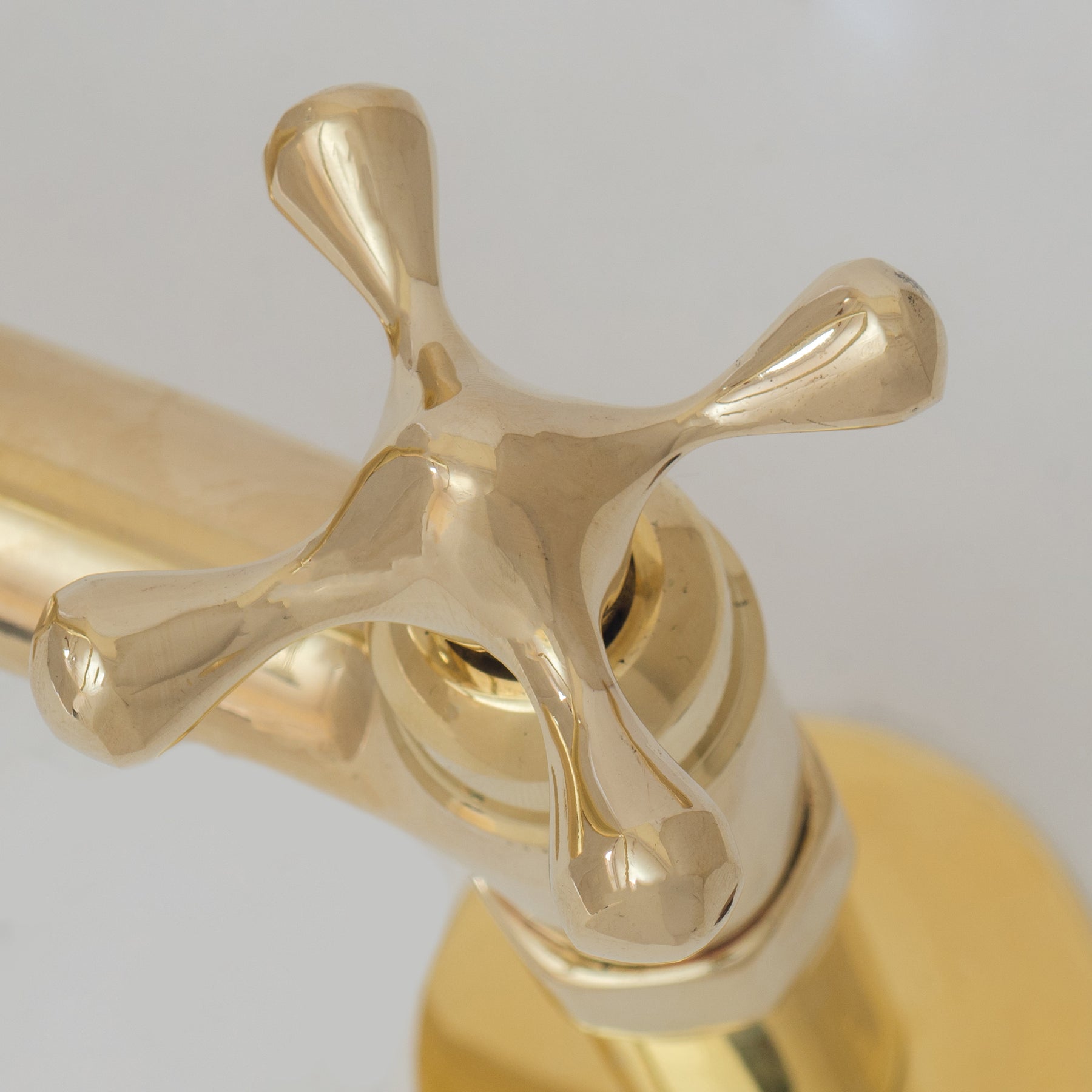
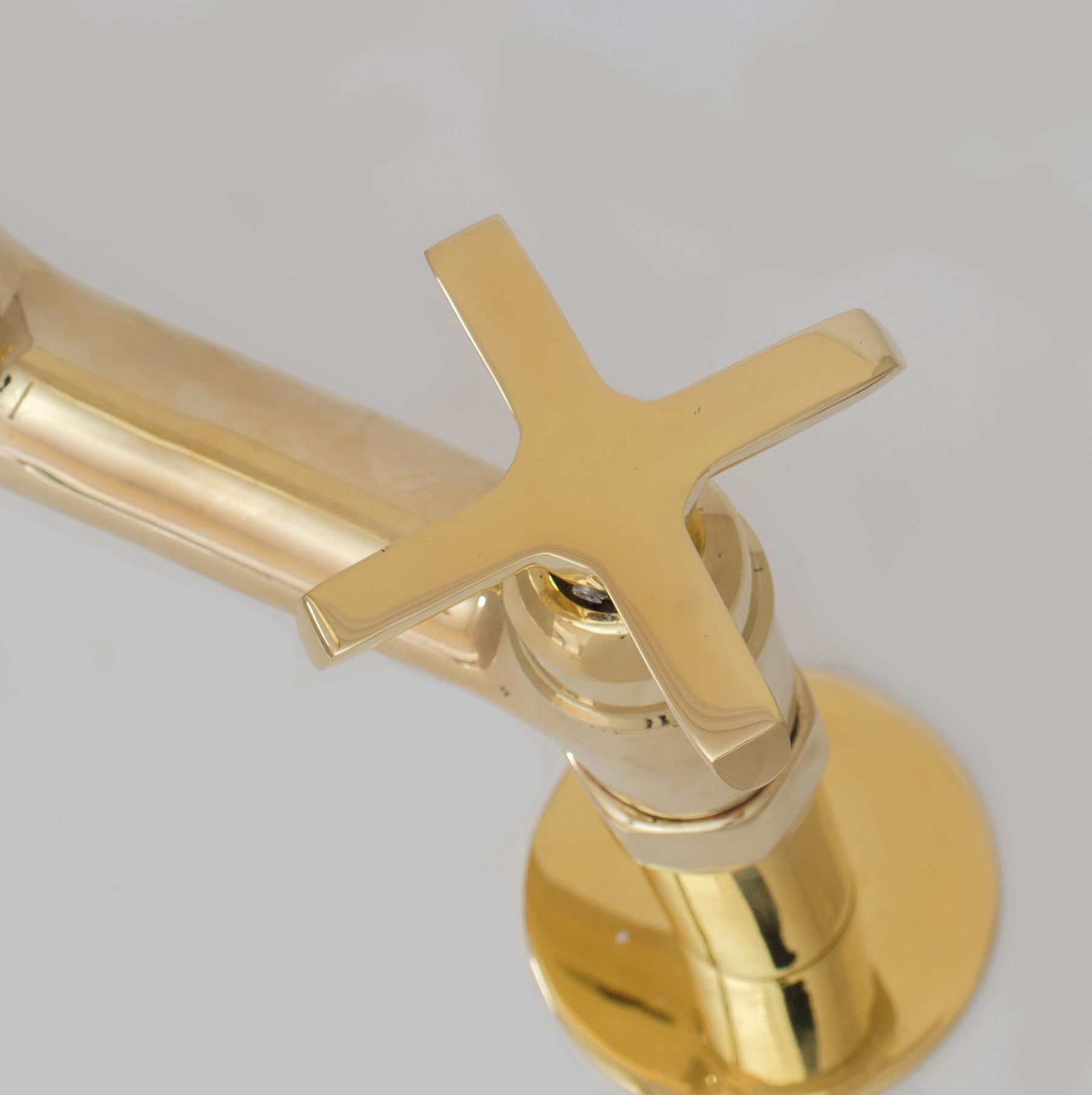
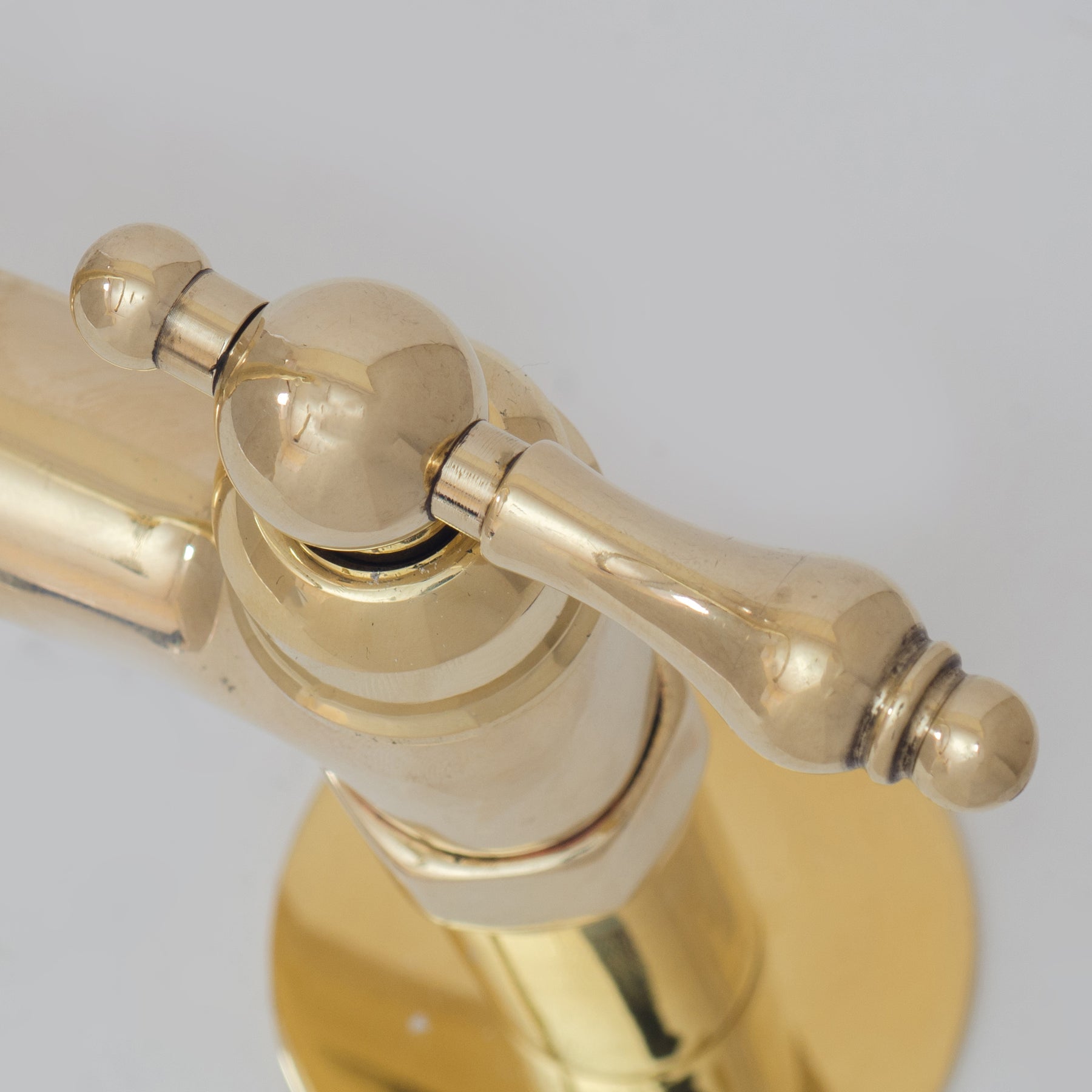
| Caractéristique | Poignées en croix | Poignées à levier |
|---|---|---|
| Esthétique | Traditionnel, classique, victorien | Transitionnel, légèrement plus moderne |
| Prise avec les mains mouillées | Plus facile à saisir sous plusieurs angles | Nécessite d'appuyer ou de traverser |
| Développement de la patine | Taux identique aux poignées à levier | Taux identique aux poignées en croix |
| Accessibilité | Plus difficile pour ceux qui ont une force manuelle limitée | Plus facile pour une force de préhension limitée |
| Adaptation à la cuisine | Méditerranéen, victorien, ferme, campagnard | Transitionnel, ferme moderne |
| Personnalisation chez Insideast | Disponible sur tous les modèles | Disponible sur tous les modèles |
La finition vieillit de manière identique quel que soit le type de poignée. Les deux sont fabriqués à partir du même laiton massif, les deux développent une patine au même rythme en fonction de la fréquence à laquelle ils sont touchés. Si vous cuisinez quotidiennement et manipulez fréquemment le robinet avec les mains humides ou savonneuses, attendez-vous à ce que les poignées développent la patine la plus rapide sur l'ensemble du luminaire. Ce n'est pas un problème. C'est ce qui donne à un robinet de cuisine son caractère après quelques années d'utilisation.
Avec ou sans douchette latérale

Fabriqué à la main pour correspondre exactement au robinet de pont
La douchette Heritage est fabriquée à partir du même laiton massif que le corps du robinet, de sorte que les deux pièces vieillissent ensemble comme un ensemble assorti. Le support de la douchette se monte dans le troisième trou de l'évier à droite ou à gauche du luminaire principal.
Une douchette latérale se connecte au corps du robinet par un troisième trou d'évier et se place dans son propre support à droite ou à gauche du robinet principal. Lorsque vous la soulevez et appuyez sur la gâchette, elle dévie l'eau du bec vers la tête de la douchette.
La question la plus courante est de savoir s'il faut en prendre une. La réponse honnête dépend de la façon dont vous lavez les légumes et de la profondeur de votre évier. Si vous rincez régulièrement de grandes passoires, frottez des casseroles avec des résidus incrustés ou rincez le bassin de l'évier lui-même, une douchette latérale accélère ces tâches. Si vous rincez principalement des verres et remplissez des casseroles, une douchette ajoute de la complexité sans grand retour.
Avec douchette latérale
- Rinçage plus rapide pour les grands produits et casseroles
- Plus facile de nettoyer le bassin de l'évier
- Nécessite un troisième trou d'évier
- Un élément de plus à entretenir au fil du temps
- Ajoute à la présence tactile en laiton de la cuisine
Sans douchette latérale
- Composition visuelle plus épurée
- Seulement deux trous d'évier nécessaires
- Rien de plus à user ou à remplacer
- Le bec col de cygne compense la portée
- Souvent préféré dans les cuisines plus minimalistes
« Leurs pièces sont 100 % en laiton et sont fabriquées au Maroc », a écrit Kaley Cutting, qui a choisi un robinet de pont et une douchette Insideast pour la rénovation de sa cuisine victorienne. « Ils ont aussi une incroyable collection d'éviers, de systèmes de douche et de quincaillerie. » Elle a utilisé la douchette ; pour le style de sa cuisine et la profondeur de son évier, c'était le bon choix.
Du point de vue de la patine, une tête de douchette en laiton développe son propre caractère car elle est manipulée séparément du robinet. Après quelques années, la tête de la douchette montrera une usure plus concentrée près de la zone de la gâchette. La plupart des clients qui voient cela le considèrent comme un témoignage honnête de l'utilisation plutôt qu'un problème.

La douchette et le robinet vieillissent ensemble, formant un ensemble assorti
Un robinet de pont avec douchette latérale installé dans la cuisine victorienne rénovée de Kaley Cutting. Après deux ans d'utilisation quotidienne, les poignées et la tête de douchette développent une patine ensemble, apparaissant comme une pièce cohérente plutôt que deux luminaires séparés.
@ourvintagevictorianhouse
Comment le laiton non verni vieillit dans un environnement de cuisine
Un robinet de cuisine est manipulé 30 à 50 fois par jour dans un foyer moyen. C'est nettement plus qu'un robinet de salle de bain. Plus de contact signifie plus d'huiles naturelles des mains, plus d'exposition à l'eau et au savon, et un développement plus rapide de la patine sur les poignées et la base du bec.
Ce que cela signifie en pratique : dans les 6 à 12 premiers mois, un robinet de cuisine à pont développe une chaleur et un assombrissement visibles aux points de contact. Les zones que vous touchez le plus, en particulier les poignées et la base du bec, montreront la teinte la plus profonde. Les zones rarement touchées, comme le dessous du pont, restent plus claires plus longtemps. Le résultat est une pièce qui semble réellement utilisée plutôt qu'uniformément vieillie. Pour la progression mois par mois avec de vraies photos de clients, le guide sur le laiton non verni et son vieillissement couvre chaque étape, du jour de l'installation à deux ans.
Ce n'est pas un défaut. C'est le même processus qui donne son caractère au cuir vieilli, ou sa profondeur au bois travaillé à la main. Cove House, l'un des studios de design qui utilise Insideast dans toutes ses rénovations, a décrit son robinet à pont comme "une finition vivante qui développe une patine avec le temps et semble être un ajout intemporel à la cuisine".
Deux choses accélèrent la patine au-delà de l'usage normal : le liquide vaisselle agressif appliqué directement sur le robinet (plutôt que sur une éponge ou un chiffon), et la vapeur d'une cuisinière positionnée directement à côté de l'évier. Si votre cuisinière se trouve à moins de 30 cm de l'évier et que vous cuisinez fréquemment avec les brûleurs allumés, attendez-vous à ce que le bout du bec et la base présentent un changement de couleur plus prononcé. Cette zone est exposée à la fois à la vapeur et à une manipulation directe, ce qui constitue l'environnement de vieillissement le plus actif pour un robinet.
Pour l'entretien quotidien, un coup de chiffon humide après utilisation suffit. Notre guide complet d'achat de robinets couvre en détail la méthode de nettoyage, y compris ce qu'il ne faut pas utiliser. En bref : pas d'abrasifs, pas de nettoyants chimiques agressifs, pas de produits de type CLR.
Quel robinet de cuisine Insideast pour quel style de cuisine ?
Les trois principaux modèles de robinets de cuisine à pont Insideast couvrent l'éventail des esthétiques de cuisine traditionnelles. Voici une analyse honnête de celui qui convient à quel espace.
Pont à pieds droits, bec droit, poignées en croix. L'option la plus classique. Convient aux cuisines victoriennes, de campagne anglaise, de ferme et méditerranéennes traditionnelles. S'accorde bien avec la quincaillerie en laiton non verni et un évier de ferme.
Bec col de cygne arqué sur une base de pont. Plus architectural de loin. Le profil plus haut fonctionne particulièrement bien sur les éviers de ferme profonds et dans les cuisines avec de hauts plafonds. Convient aux espaces méditerranéens, coloniaux espagnols et transitoires.
Proportions transitoires : le pont est légèrement plus bas, les lignes sont plus épurées sans perdre le format classique. Se situe entre Heritage et Verdeau en termes de sensation. Convient aux cuisines transitoires où le design n'est pas entièrement traditionnel mais qui souhaitent tout de même une présence de laiton.
Les trois modèles peuvent être spécifiés avec des poignées en croix ou à levier, avec ou sans douchette latérale, et dans des dimensions personnalisées si nécessaire. Parce qu'Insideast fabrique tout dans son atelier de Marrakech, des ajustements à la hauteur du bec, au style des poignées et à l'espacement des trous sont possibles sur demande. Ce n'est pas quelque chose que les marques revendeuses peuvent offrir.
J'ai passé des mois à chercher le bon robinet, le remplisseur de casseroles, les boutons et les tirettes d'appareils pour cette cuisine. J'ai eu du mal à trouver des luminaires qui coordonnaient tous, et qui n'avaient pas l'air ou la sensation d'un or bon marché. Finalement, j'ai choisi le laiton non verni (brut). J'ai commandé mes robinets chez @insideastdesigns.

Si vous ne savez pas quel modèle convient à votre cuisine, le raccourci le plus fiable est d'examiner vos autres luminaires et quincaillerie. Si vos poignées et charnières d'armoires sont de caractère traditionnel ou victorien, Heritage est presque toujours le bon choix. Si votre cuisine a des lignes plus douces et plus européennes, Verdeau a tendance à mieux s'intégrer. Si vous ne pouvez pas vous décider, le Bridgeford fonctionne avec les deux.
Vous pouvez parcourir la gamme complète sur la collection de robinets de cuisine en laiton non verni sur Insideast, ou explorer spécifiquement la collection de robinets de cuisine à pont si vous avez déjà opté pour ce format.
Si vous hésitez encore entre les robinets de cuisine et de salle de bain, ou si vous comparez le laiton non verni à d'autres finitions, le guide complet de l'acheteur de robinets en laiton non verni couvre en détail la décision plus large.
Questions fréquemment posées
Questions courantes sur les robinets de cuisine en laiton non verni
Quel est le meilleur robinet de cuisine en laiton non verni ?
Il n'y a pas de meilleur robinet de cuisine en laiton non verni, car le bon choix dépend de la configuration de votre évier, du style de votre cuisine et de votre façon de cuisiner. Si vous avez un évier de ferme profond et que vous souhaitez un look plus spectaculaire, le pont col de cygne Verdeau est le bon point de départ. Si vous voulez un profil victorien classique pour une cuisine traditionnelle, le pont Heritage est le meilleur choix. Si vous avez besoin de quelque chose qui fonctionne avec une plus large gamme de styles, le Bridgeford se situe entre les deux. Tous trois sont 100 % en laiton massif, fabriqués à la main à Marrakech, et développent la même patine vivante au fil du temps.
Robinet à pont ou col de cygne : lequel est le meilleur ?
Un robinet à pont et un robinet col de cygne ne sont pas mutuellement exclusifs. Un col de cygne est une forme de bec ; un pont est un format de robinet avec deux poignées séparées reliées par un pont horizontal. Vous pouvez avoir un robinet à pont avec un bec col de cygne ou un bec droit. La version col de cygne (comme le Verdeau) offre plus de dégagement pour remplir de grandes casseroles et a un aspect plus architectural. La version à bec droit (comme le Heritage) est plus discrète et aux proportions classiques. Lequel est le meilleur dépend de la profondeur de votre évier et du poids visuel que vous souhaitez que le robinet ait dans l'espace.
Quel style de robinet de cuisine est le plus populaire en ce moment ?
Le robinet à pont avec poignées en croix en laiton non verni est le choix dominant dans les rénovations de cuisine haut de gamme depuis trois à quatre ans, en raison du retour général aux esthétiques de cuisine traditionnelles et méditerranéennes. La variante col de cygne a connu une croissance plus rapide au cours des 18 derniers mois, les éviers de ferme étant devenus plus courants. Les robinets à trou unique en laiton non verni sont également de plus en plus populaires pour les petites cuisines ou les rénovations où le perçage de trous d'évier supplémentaires n'est pas pratique. Les trois formats sont bien représentés dans les publications de design actuelles.
Combien de temps durent les robinets de cuisine en laiton non verni ?
Un robinet en laiton massif fabriqué selon les spécifications traditionnelles durera 20 à 30 ans avec un entretien ordinaire. Le mot clé est solide : un robinet entièrement en laiton, plutôt qu'un corps en zinc plaqué laiton, ne se piquera pas, ne se corrodera pas et ne perdra pas son intégrité structurelle au niveau de la couche de finition. Les cartouches (le mécanisme de valve interne) sont la pièce la plus susceptible d'être remplacée, généralement après 10 à 15 ans d'utilisation quotidienne, et ce sont des cartouches à disque céramique standard disponibles chez la plupart des fournisseurs de plomberie. Le corps en laiton lui-même dure bien plus longtemps que les cartouches.
Quels sont les inconvénients des robinets de cuisine en laiton non verni ?
Le principal inconvénient du laiton non verni est qu'il nécessite un entretien plus attentif que le chrome ou les finitions laquées. Les nettoyants chimiques agressifs, les brosses abrasives et le liquide vaisselle fort appliqué directement sur le métal décaperont ou accéléreront la patine de manière inégale. La finition vieillit également de manière visible et continue, ce qui convient aux personnes qui souhaitent une finition vivante, mais peut être un inconvénient pour celles qui préfèrent une apparence statique et uniforme. Dans les environnements très humides ou près des sources de vapeur, le développement de la patine est plus rapide. Aucun de ces éléments n'est un problème si vous savez à quoi vous attendre. Ils ne deviennent des problèmes que lorsque les acheteurs s'attendent à ce que le laiton non verni se comporte comme le laiton laqué ou le chrome.
Ai-je besoin d'un plombier pour installer un robinet de cuisine à pont ?
Si vous remplacez un robinet à pont existant avec la même configuration de trous, l'installation est une tâche de plomberie simple que de nombreux propriétaires peuvent effectuer eux-mêmes. Si vous passez d'un robinet à trou unique à un robinet à pont, vous aurez besoin de deux trous supplémentaires percés dans votre plan de travail ou votre comptoir, ce qui nécessite généralement un professionnel. Les conduites d'alimentation des robinets à pont Insideast utilisent des raccords standard NPT 1/2" (US) ou BSP sur demande pour les installations au Royaume-Uni et en Europe. Les deux sont compatibles avec les tuyaux d'alimentation flexibles standard disponibles dans n'importe quelle quincaillerie.
Insideast conçoit et fabrique chaque robinet de cuisine dans son atelier de Marrakech. Pas de marge de revendeur, pas de commande minimum, et des dimensions personnalisées disponibles sur demande. Parcourez les robinets de cuisine à pont ou découvrez la collection complète de robinets de cuisine pour voir tous les styles et configurations.


