


Handmade solid copper and brass outdoor shower systems from the Insideast workshop in Marrakech. Each fixture develops its own patina with every season.
A brass outdoor shower changes how you use a home. Whether it is rinsing off after a swim, a cool-down beside a campsite sauna, or a full open-air bathing experience at a coastal property, the choice of material defines both how long the fixture lasts and how well it ages while doing it. Brass and copper are the natural answer: both handle moisture without a protective coating, develop richer character with every season, and age alongside the property rather than against it. This guide covers which material to choose, what to expect from the patina outdoors, how installation differs from interior work, and how properties from beachside Airbnbs in Tasmania to campsite saunas across Europe are already making them work.
- Both unlacquered brass and solid copper resist moisture without a coating and are genuinely suited to permanent outdoor installation.
- Copper patinas faster outdoors and will reach verdigris green over the long term. Brass develops more slowly and stays in the warm brown range for most of its life.
- A rain shower head is the most practical outdoor choice: no flexible hose to perish in UV, no temperature-sensitive parts exposed to the elements, and a natural cascade that suits garden and poolside settings equally.
- Outdoor installation requires planning for drainage, pipe frost risk in cold climates, and UV exposure on fittings.
- The fixture will look better after several seasons outdoors than it did on installation day.
- Why brass and copper are built for outdoor use
- Unlacquered brass vs copper: which weathers better?
- Rain shower heads outdoors: what to expect
- Mounting and installation for outdoor shower systems
- How the patina develops differently outside
- Pool house, garden and coastal installations
- Frequently asked questions
Why brass and copper are built for outdoor use
Most bathroom fixtures are designed for interior conditions: stable temperature, controlled humidity, and no direct UV exposure. An outdoor shower exists in a completely different environment. It faces sun, rain, frost in colder months, and in coastal settings, salt air. Most plated metals -- brushed nickel, chrome, matte black -- begin to fail in these conditions because the surface layer cracks or lifts before the base metal shows any real wear.
Brass and copper behave differently. Both are solid metals through and through, with no applied coating that can peel or chip. The Copper Development Association confirms that outdoor atmospheric exposure causes a thin protective patina to form on brass and copper alloys, which reduces the rate of surface change over time rather than accelerating it. The longer the fixture is outside, the more stable the surface becomes.

Solid brass, built for outside
The same quality indoors and out
Because Insideast fixtures are solid brass or solid copper all the way through, there is no plated layer that can fail outdoors. What you see on day one is the full depth of material -- and what develops over time in an outdoor setting is richer, not worse.
Browse the full range of exposed shower systems suited to outdoor installation.
This is the same principle behind copper roofing, brass marine fittings, and architectural copper cladding -- all materials chosen because they perform in exposed outdoor conditions for decades. A solid copper rain shower head mounted in a garden wall operates on identical material logic.
One condition worth noting: fixtures in direct saltwater spray, within a few metres of breaking waves, will develop a patina faster and with more surface texture. This is not damage. It is the material responding to a richer environment. A position with some natural shelter from direct spray slows the process without affecting the fixture's function or lifespan. If you are still deciding whether unlacquered brass suits an indoor shower before committing to an outdoor installation, we covered how the material handles interior shower conditions in Can You Use Unlacquered Brass in a Shower?

"Item is as described, very nice. Also received earlier than expected."
Unlacquered brass vs copper: which weathers better?
Both materials hold up well outdoors. The difference is in how each one changes over time: in pace, in colour direction, and in the aesthetic they eventually settle into.
Copper is the more reactive of the two. It begins changing within weeks of outdoor exposure, moving from its initial orange-red through deepening amber and chocolate tones before eventually reaching the verdigris green most people associate with aged copper architecture. How quickly this happens depends on your climate. A humid coastal property may reach deep verdigris within a few seasons. A drier inland setting takes considerably longer, holding the rich chocolate-brown phase for much of its visible life.
Unlacquered brass is more stable. Because brass is an alloy of copper and zinc, it responds to moisture and oxidation more slowly. Outdoors, it deepens from warm yellow-gold through amber and brown before settling into a rich dark tone. In most climates it will develop subtle green highlights in areas of consistent water contact -- typically at the shower arm junction or around the face plate -- but rarely turns fully green across the body of the fixture.
| Feature | Unlacquered Brass | Solid Copper |
|---|---|---|
| Starting colour | Warm yellow-gold | Bright orange-red |
| Patina speed outdoors | Moderate | Fast |
| Established colour | Rich warm brown | Deep chocolate to teal |
| Long-term finish | Dark amber-brown, subtle green highlights | Classic verdigris green |
| Best outdoor setting | Coastal modern, spa, minimalist garden | Garden, rustic, tropical, bohemian |
| Maintenance outdoors | Occasional wipe-down keeps patina even | Largely self-managing; slower if oiled annually |
The choice often comes down to setting and aesthetic direction. A coastal property with natural materials -- timber, stone, rattan -- tends to suit solid copper, which reads as organic and raw. A spa-style pool terrace or minimalist garden pavilion often suits unlacquered brass better, where the warm brown patina bridges polished and natural surfaces without going fully green.
Installed outdoors
Double copper, one wall
When two shower systems share a wall outdoors, the patina development tells its own story. Water-contact points deepen first, UV-exposed areas follow, and after a season the surface reads as something that belongs in that environment.

Double outdoor copper shower. Natural materials under the sky. Photo: @countryside100_
Rain shower heads outdoors: what to expect
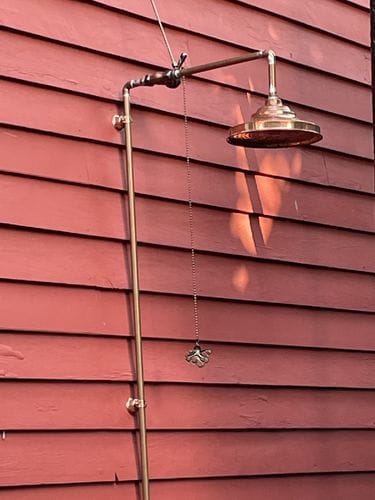
A rain shower head is the most practical outdoor option. There is no handset to crack in UV, no flexible hose to perish in heat, and no temperature-sensitive components exposed to the elements. The face plate and arm are solid metal throughout, which means the fixture is effectively weather-independent once installed correctly.
The outdoor shower head
Overhead cascade, every time
In a garden, beside a pool, or next to a sauna, standing under a wide, even rainfall stream feels genuinely different from anything an indoor enclosure provides. The scale of the fixture reads better against an exterior wall, and for properties with pergola structures or higher external walls, a ceiling-mounted configuration gives the most dramatic result.
Round shower heads age more uniformly outdoors than square ones. Water contact is distributed evenly across the face plate, which means the patina develops in a consistent pattern across the entire surface.

For most outdoor installations, a solid copper round rain shower head is the natural starting point: the material handles exposure without any additional treatment, and the round format provides the most even water distribution. For properties where brass fixtures are already in use indoors, a brass rain shower head keeps the material consistent across the whole property.
"Absolutely amazing shower head. A piece of art for my outdoor shower. Thanks so much!"
For a full breakdown of brass and copper shower head types, including handheld and ceiling-mount options, see the complete brass shower head guide.
Mounting and installation for outdoor shower systems
Outdoor shower installation follows the same basic principles as interior work: supply lines, pressure balance, and secure wall fixing. A few additional considerations make the difference between a fixture that lasts decades and one that develops problems within a few seasons.
Wall material and fixings
Stone and masonry walls are the most forgiving base for outdoor shower fixtures. Their thermal mass is high, they are UV-stable, and fixings remain secure through seasonal expansion and contraction cycles. Timber walls require stainless fixings rather than galvanised ones to avoid staining the wall surface as the fixing oxidises over time. If the wall is a lightweight cladding panel, a backing plate mounted to the structural frame behind it provides the rigidity a shower arm needs under daily load.
Supply and pipe routing
In climates where temperatures drop below freezing, exposed supply pipes need insulation or a shut-off and drain-down valve that allows the line to be emptied seasonally. Copper pipe on the supply side is the natural match for a copper or brass system: the materials are compatible, and if any soldering is required during installation the metals behave consistently under heat. Standard 1/2" connections are used across all Insideast shower systems.
Drainage
An outdoor shower draining onto well-draining garden ground is the simplest setup. For hard-surface terraces and pool decks, a solid brass floor drain recessed into the paving gives a clean finish and routes water away properly. The drain finish can be matched to the shower system material for a cohesive result across the whole installation.
Exposed brass shower system at full flow. View on Instagram by @insideastdesigns
The pressure and spread from an exposed brass shower system with a sprayer changes how the whole fixture reads in a space. At full flow, the rainfall head delivers a wide, even stream. The visible pipework -- wall arm, risers, valve bodies -- becomes part of the installation rather than something to conceal.
This is one reason exposed systems suit outdoor installations particularly well. The architecture of the pipework is visible and intentional, complementing exterior wall materials in a way that a recessed fitting never could.
Plan before ordering
- Confirm pipe access: hot and cold supply, or cold-only rinse
- Assess wall material and choose fixings accordingly
- Check frost risk and plan seasonal pipe drain-down if needed
- Set shower arm height -- allow 5 to 10 cm above indoor height for barefoot use
Accessories to consider
- Solid brass floor drain for hard-surface terraces
- Brass holder or caddy if used as a full wash station
- Stainless wall fixings for timber surfaces
- Pipe insulation sleeve for above-ground supply lines in cold climates
How the patina develops differently outside
The same process that creates a patina on an indoor brass or copper fixture happens outdoors -- but faster, and with more variation across the surface. Indoors, a shower fixture encounters moisture in controlled cycles. Outdoors, it encounters moisture from rain and dew, UV from direct sunlight, and temperature swings that cause the metal to expand and contract. Each of these accelerates the surface chemistry that creates patina.
The result is a finish that arrives sooner and settles into a richer state than an equivalent indoor fixture would reach in the same period. Areas of most consistent water contact -- the underside of the shower arm, the face plate where water flows, the valve handles -- develop the deepest colour first. Areas exposed more to UV than to water follow at a slower pace, creating a natural gradient across the fixture.
Unlike interior fixtures, outdoor brass and copper do not need to be cleaned to maintain their structural integrity. The patina is not dirt -- it is the metal's own surface layer reorganising in response to its environment. If you want to slow the process, an occasional application of natural wax or food-grade mineral oil to dry metal delays further oxidation without sealing the surface permanently.

Relaxing rain like showers. Photo by @insideastdesigns

"Such lovely products. I've bought a number of items over the years and they are beautiful and last well."
Laurel has purchased from Insideast on multiple occasions over several years. Her note that the pieces "last well" reflects a consistent experience from customers using both brass and copper fixtures in high-exposure settings over extended periods.
Pool house, garden and coastal installations
Outdoor showers serve different functions depending on the property. A pool house shower is primarily a rinse station: cold-only, used frequently, often in full sun. A garden shower in a walled courtyard may be used year-round as a full bathing station. A coastal property shower faces salt air in addition to moisture. Each setting places different demands on the fixture, and each suits brass and copper for slightly different reasons.
Pool house and terrace
Pool-side showers operate in high UV and high water-contact conditions. Solid copper handles both well. The patina that develops here has a distinctive appearance: the face plate of the shower head deepens faster than the arm, creating a gradient that reads as genuinely lived-in. An exposed shower system with pipework surface-mounted to a rendered or stone wall gives the cleanest visual result and keeps all connections accessible for the occasional inspection.
Garden and walled courtyard
A sheltered garden shower benefits from being mounted on a feature wall rather than a fence post wherever possible. Stone or brick gives better thermal stability and more secure fixing over years of seasonal movement. In a walled garden, the patina develops more slowly than in a fully exposed coastal setting, giving a more controlled, gradual result. This is the context where unlacquered brass performs particularly well: the warm brown it settles into complements planting and natural materials without competing with them.
Coastal and high-humidity
In coastal settings, salt air is the most significant variable. It accelerates patina development substantially and causes surface pitting on low-quality or plated metals. On solid copper and solid brass, however, the salt-air patina is a recognised and valued aesthetic -- the same chemistry visible on copper roofing in maritime cities. If the fixture is within direct spray range of breaking waves, a periodic fresh-water rinse of the exterior pipework keeps the patina developing evenly across the surface.

@sol_at_sisters_beach_airbnb, Sisters Beach, Tasmania. View on Instagram
Real installation
Sisters Beach, Tasmania
"Located at Sisters Beach, Tasmania, Sol is fully equipped so all you need to pack are the basics. Our goal is to make your holiday effortless, relaxing and stress-free."
Choosing a fixture for how it will look after years of outdoor exposure, not just on move-in day, is the approach that makes a property memorable to guests who return.
Design project
When the fixture is part of the brief
For properties where the outdoor shower is part of a designed scheme, working with a designer who understands natural metal finishes makes a measurable difference. The fixture becomes part of the architecture's material language rather than an item mounted to a back wall.
I'm glad @carolineturnerinteriors made it work to have this beautiful result.


"Great item, just as I needed it."
Frequently Asked Questions
Common questions about outdoor brass and copper showers
Can you use brass fixtures outdoors?
Yes. Solid brass is built for outdoor conditions. It does not rust, and without a lacquer coating it develops a natural patina in response to moisture and UV exposure. The finish changes over time, but the material itself does not degrade. Proper installation and occasional maintenance extend the life of any outdoor brass fixture significantly.
Do copper shower heads work outside?
Copper shower heads are one of the strongest outdoor choices available. Copper is inherently resistant to corrosion and develops a protective oxide layer over time. The patina that forms outdoors -- from warm amber to deep verdigris green -- is both a cosmetic feature and a protective one. Solid copper shower heads handle rain, humidity, and UV exposure without structural loss.
What is the best outdoor shower fixture?
A solid copper or unlacquered brass rain shower head paired with an exposed shower system is the most durable and visually striking outdoor choice. Avoid chrome or plated finishes outdoors: the plating eventually fails. Solid material fixtures, particularly copper and brass made from a consistent alloy throughout, are built for exactly this kind of long-term outdoor exposure.
The right choice for the long view
A brass outdoor shower or copper outdoor shower is not a compromise between interior quality and outdoor practicality. It is the opposite: a fixture that performs better outside than most alternatives would, developing a finish over time that no factory-applied coating can replicate. The patina is not a side effect of placing it outdoors. It is the point.
Whether you are planning a pool terrace, a garden shower beside a sauna, or a fully equipped bathing station at a coastal rental, the material logic is the same. Start with solid copper for the fastest and most expressive patina. Choose unlacquered brass if you want a slower, warmer development that stays in the brown range for most of its life.
Browse outdoor brass and copper shower systems, or explore the solid copper rain shower head as a starting point for a garden or poolside installation.


