


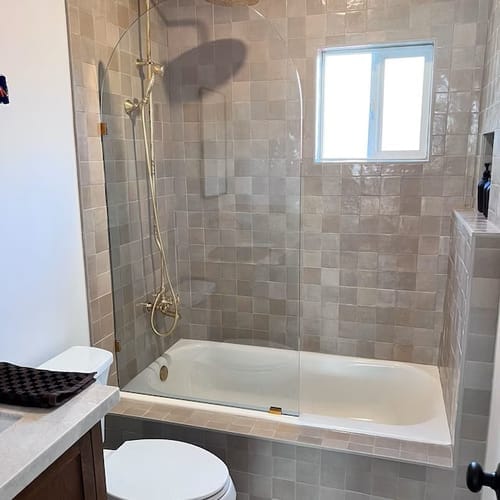
An Insideast built-in brass shower system, handmade in Marrakech. The warm tone is unlacquered solid brass developing its living finish.
Nobody actually worries about the plumbing. What buyers want to know is whether the finish survives daily use, and whether it still looks good two years in. Brandon R. installed an exposed brass shower system, watched the patina arrive within weeks, and ended up ordering every other bathroom fixture from the same Marrakech workshop. A boutique Airbnb in Costa Rica specified custom brass shower faucets for a renovation in a tropical climate, with humidity far beyond a standard home bathroom, and reported no concerns with the finish. These are not exceptional cases. This is what unlacquered brass in a shower looks like in normal use. For outdoor-specific installations, the outdoor brass and copper shower guide covers everything from poolside to coastal environments.
The honest answer is yes, it works, and the wet environment actually develops the patina faster and more evenly than almost anywhere else in the home. Here is exactly what happens at every stage, and what to expect from the day it is installed.
- Solid brass does not corrode or weaken in water. The finish ages. The metal underneath remains structurally sound.
- Shower humidity accelerates patina development compared to a dry kitchen or bathroom. The colour shift is warm amber, not green.
- Both exposed pipe and built-in concealed systems are available in unlacquered brass. The choice is aesthetic, not technical.
- Insideast shower systems use 1/2" BSP connections, compatible with standard UK, US, and Australian plumbing.
- Harsh chemical cleaners and very poorly ventilated steam showers are the only real risk. Normal domestic use is not.
The honest answer: yes, with the right conditions
Brass is an alloy of copper and zinc. In water, it resists corrosion because neither metal reacts aggressively with clean water under normal domestic conditions. There is no rust, no rot, no structural decay. A solid brass shower system installed today will be mechanically sound in twenty years. The finish, however, will look completely different, and that is the point.
In a shower environment, unlacquered brass develops its living finish patina faster than in a dry space. Daily water contact and steam accelerate the oxidation process that would happen gradually elsewhere. In a dry kitchen, the first warm amber tones appear over several months. In a shower, you will see them within the first few weeks. By the time a kitchen fixture is just beginning to show character, a shower system has already settled into a rich, established tone.
For most buyers who have chosen unlacquered brass specifically for its living finish, a shower is one of the best places to install it. The patina develops more evenly, more visibly, and more quickly than in almost any other location in the home. The conditions to avoid are simple: harsh chemical cleaners, bleach-based products, and very poorly ventilated steam enclosures. A wipe with warm water after use is the only maintenance the finish needs. Our guide to cleaning unlacquered brass without damaging the patina covers all of this in detail.
"Absolutely stunning. The natural patina that is already appearing is beautiful. I have purchased every bathroom fixture from Insideast."
What daily shower humidity does to unlacquered brass
Brass oxidizes when its surface copper reacts with oxygen and moisture in the air. In a shower, this process is continuous rather than intermittent. Steam, water contact, and the warmth of an enclosed bathroom all contribute to a patina that builds up evenly and consistently across the entire surface, rather than only at touch points the way it does on a kitchen faucet.
The key distinction: surface patina and structural integrity are two separate things. The appearance of the fixture changes significantly over time. The metal does not. Solid brass does not thin, weaken, or hollow with water exposure. What changes on the surface is a cosmetic process on the outermost layer of the metal. The weight, the threads, the connections, the valve cartridges, all of this remains unchanged over years of daily use.

Insideast rain shower head: 1/32" precision holes, hand-drilled in the Marrakech workshop.
Workshop Detail
1/32" precision holes, hand-drilled in Marrakech
Every Insideast rain shower head is drilled by hand in the workshop. The 1/32" diameter holes provide a consistent, rain-like flow and do not widen or deform with regular water use. The solid brass construction means the holes retain their shape indefinitely. Copper shower heads use 22-gauge high-quality copper for the same reason: the material holds its form and does not corrode around the water outlets, even under high pressure and continuous daily use.
"I'm really happy with this shower head, great quality and beautiful finish."
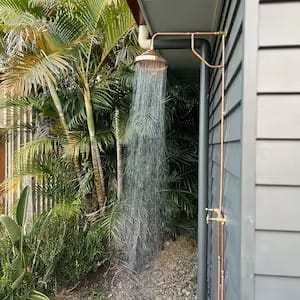
Rain shower vs handheld: which ages more gracefully
Both age well. The character of the aging differs, and that difference is worth understanding before you choose your system configuration.
A rain shower head sits fixed overhead. Water flows through all holes evenly and continuously. Patina develops across the entire face at roughly the same rate, which produces the most uniform and cohesive result. The overhead position also means water drains cleanly after each use rather than pooling on the surface, reducing the chance of concentrated water marks appearing in any one spot.
A handheld unit has more surface variation. The hose connection, the body, and the spray face each experience different levels of water contact. The area around the hose fitting, where water can sit between uses, may develop slightly faster than the spray face itself. This variation in patina across a handheld adds to the character rather than detracting from it, since different tones develop across different sections of the piece. The overall result is still excellent.
The exposed pipe system combines both. The pipe column, the diverter valve, the rain head, and the handheld all age in parallel. This is the most visible and most complete aging of any configuration, and for buyers who chose unlacquered brass specifically for its character, it tends to be the most satisfying long-term outcome. For a full comparison of brass shower head types, sizes, and materials, see the complete brass shower heads guide.
Rain Shower Experience
The feeling of a solid brass rain shower head
The weight of a solid brass shower head is part of the experience from the first use. Unlike polymer or brass-coated zinc alternatives, the density is apparent the moment you hold it. The wide face distributes water evenly across its surface, and the unlacquered finish means that surface ages continuously to a deeper, richer tone over time. Many buyers describe the long-term result as closer in character to a spa fitting than a standard domestic shower head.

Unlacquered solid brass rain shower head, tested under high water pressure, for indoor and outdoor use.
"Thanks to our friends at Insideast for creating these custom made brass shower faucets all the way from Morocco. Loving our custom made brass shower faucets from Morocco."

Built-in vs exposed: installation and look compared
The choice between an exposed system and a built-in concealed system comes down to two things: the look you want on the wall, and where you are in the renovation sequence when you make the decision.
Exposed systems mount to the wall surface directly. The pipe column, shower arm, diverter, and controls are all visible. This is the traditional option, and the one that shows the most of the unlacquered brass finish over time. Installation requires drilling two holes with a center spacing of 5 3/4" (146mm), fitting the Z-connector to the wall water outlet, and securing the pipe column with anchors. Teflon tape is applied to all threads, and handle cartridges are secured with a hex key. The full 13-step process uses standard plumbing tools and most experienced plumbers complete it in half a day.
Built-in concealed systems place the mixing valve body inside the wall cavity, with only the trim plates and controls visible at the surface. The result is clean and architectural. Installation must happen before tiling, so the decision cannot be delayed mid-project. If you are in the rough-in phase of a full bathroom renovation, the concealed system gives a very clean finish at the wall. If the bathroom is already tiled, the exposed system is the practical answer.
Exposed System
- All pipework visible on wall surface
- Maximum unlacquered brass character on show
- Can be retrofitted to an existing finished bathroom
- Standard installation, most plumbers comfortable with it
- 5 3/4" (146mm) hole spacing center-to-center
- Teflon tape on all threads, hex key for handle cartridges
Built-In Concealed System
- Only trim plates and controls visible at wall surface
- Clean, minimal, architectural appearance
- Requires installation before tiling
- Valve body inside wall: harder to access for repairs
- More complex rough-in than exposed systems
- Suited to minimalist and contemporary bathroom designs
Water pressure and installation: what you need to know
Insideast shower systems use 1/2" BSP connections, compatible with standard plumbing in the UK, US, and Australia. No specialist pipework is required beyond what a standard bathroom installation involves. The shower heads are tested under high water pressure and designed to deliver a genuine rain-like experience with standard domestic supply.
One practical note before ordering for a US installation: some local building codes require pressure balance and anti-scald valves in shower systems. This is a code requirement, not a product limitation. One of our customers, Trish, encountered this when ordering for her original project and noted that buyers should check local code requirements before installation begins. She confirmed that where those requirements were met, the Insideast hardware performed exactly as intended. If you are unsure about your local code, a licensed plumber can advise before you begin. For UK installations, Building Regulations Part G covers water fitting standards and your plumber will be familiar with what applies.
"Received my copper shower rose today. Wow it's beautiful, the workmanship is excellent. It's solid not flimsy. Matched the description perfectly. Very happy customer."
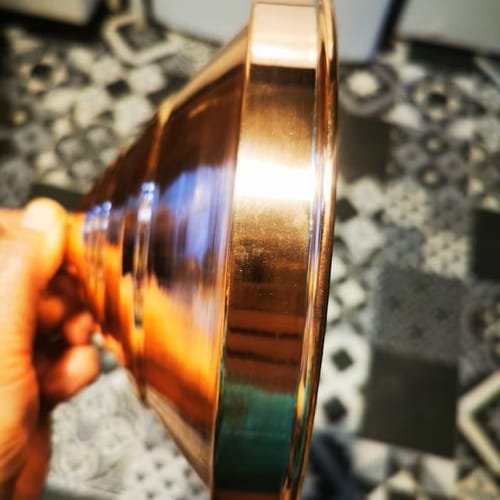
The patina in a wet environment: what it actually looks like over time
The most useful way to understand the finish over time is to compare the wet shower environment directly to a dry bathroom or kitchen. The chemistry is the same in both. The rate and character of the development differ.
What the table shows is that a shower does not produce a worse outcome than a dry space. It produces a different timeline to the same destination. The long-term result in both environments is a warm, deeply aged unlacquered brass surface with genuine character. The shower simply gets there faster.
In the shower specifically, the areas around the controls, where hands make daily contact, move fastest. The shower head face, where water is most constant, develops an even, slightly deeper tone across the whole surface. The pipe column, where water contact is less direct, tends to keep a warmer and slightly lighter tone around the mid-section. This natural gradient is something many buyers find more interesting than uniform aging. Design blogger boxwoodandspruce, who installed an Insideast exposed shower system in her own home, described the result in her overview of unlacquered brass hardware as giving a space genuine richness and luxury, unlike anything else at the price point. The lived-in quality that unlacquered brass develops in a wet environment is exactly what polished and coated surfaces cannot replicate.
Green patina in a shower is genuinely uncommon with normal water and good ventilation. If it does appear, it is removed with warm water and a small amount of lemon juice. Our full article on whether unlacquered brass turns green covers exactly when verdigris forms and confirms that standard shower use does not produce it in typical home conditions.
"Each and every one I use and love in our very own home! Like this gorgeous shower system from Insideast. So keep swooning brass lovers. It's no longer so far out of reach!"

Frequently Asked Questions
Can you use unlacquered brass in a shower?
Yes. Unlacquered brass performs well in shower environments. Solid brass does not corrode or weaken in water. Daily water exposure accelerates the patina, producing warm amber and honey-brown tones faster than in a dry space, but it does not damage the fixture structurally or aesthetically. Many buyers find that the shower environment produces the most satisfying patina development because it is even, consistent, and visually rewarding over time.
What are the cons of unlacquered brass in a shower?
The finish changes colour over time and requires minimal maintenance to keep it looking its best. A quick wipe after use prevents water spot concentration. Harsh chemical cleaners and bleach-based products should be avoided, as they can strip the developing patina unevenly. In very poorly ventilated steam showers or coastal environments with salt air, green patina (verdigris) is possible but uncommon in standard domestic bathrooms. The colour change is not a defect. It is the defining quality of an unlacquered finish.
What are the disadvantages of a concealed shower system?
Concealed shower systems are harder to access for maintenance and repairs, since the valve body sits inside the wall cavity. Installation must happen before tiling, so the decision cannot be left until the renovation is already underway. The installation process is more complex than an exposed system and typically requires a plumber with specific experience in concealed valve work. The visual result is clean and architectural, but the trade-off is higher installation complexity and less accessibility over the life of the bathroom.
How do you clean unlacquered brass shower fixtures?
Warm water and a soft cloth after each use is enough for regular maintenance. For a more thorough clean, a small amount of diluted mild dish soap can be used, then rinsed thoroughly and dried. Avoid any abrasive cleaners, scouring pads, or products containing bleach, ammonia, or strong alkalis. These will strip the patina unevenly and may cause visible spotting. If green verdigris appears, half a lemon applied to the area and rinsed off removes it cleanly without damaging the underlying brass.
Does brass rust in a shower?
No. Brass does not rust. Rust is specific to iron and steel alloys. Brass, being a copper-zinc alloy, contains no iron and cannot produce iron oxide (rust). It will develop patina over time, which is a surface oxidation process on the outermost layer of the metal. This is cosmetic and does not weaken the structure. Even with daily water contact in a shower environment, solid brass maintains its structural integrity indefinitely.
If you are ready to see the full range of exposed pipe and built-in brass shower systems made in the Marrakech workshop, browse the Insideast shower collection and find the configuration that suits your bathroom.


